Learn more Webcast featuring eSpOT-ON
Explore More eSpOT-ON Nuclease Protein Available Now
Explore More Order eSpOT-ON Nuclease mRNA Now
PRODUCT

Research sgRNA

Early discovery breakthroughs in therapeutic development begin with research single guide RNA (sgRNA).

Description

Best-in-Class sgRNA

Synthego’s research-grade sgRNA delivers high-quality, synthetic guides engineered for consistent performance across novel, engineered, and well-established nucleases.

Having synthesized over 1 million sgRNAs with up to 99% editing efficiency, we give researchers the performance, customization, and scalability needed at every step to move from early discovery to clinical development with confidence.

When it's time to advance to preclinical and clinical work, our true cGMP sgRNA provide the regulatory-grade quality required for submission-ready programs. Partner with a manufacturer equipped to support you throughout the entire journey.

Key Features

Broad Nuclease Compatibility:
Engineered for use with a wide range of CRISPR nucleases to support efficient editing across research applications.

Flexible Chemical Modifications:
Available as standard, custom, and unmodified formats, enabling you to tailor sgRNA stability and performance to your experimental needs.

Scalable Production:
Offered in multiple lengths, yields, and purification options to support projects from early discovery to advanced research studies.

Synthego really stands out because I'm not sure if there are many others that can offer screening scale, research use guides for your lead discovery, medium to large scale RUO guides for your preclinical and pharmacology studies, and ultimately larger scale GLP Tox and clinical grade material for early and hopefully ultimately late phase trials.
Mark DeWitt, Ph.D.
ASSOCIATE DIRECTOR, MAMMOTH BIOSCIENCES

Specifications

Pricing Starting At:
    1.5 nmol: $84.50 3 nmol: $119.75 5 nmol: $165.00 10 nmol: $246.00 20 nmol: $404.00 50 nmol: $760.00 100 nmol: $1,040.25
Deliverables:
    Synthetic Research sgRNA in tube or plate format (dry) One 1.5 mL Nuclease Free TE Buffer (10 mM Tris, 1 mM EDTA - ph 8.0) - for every 50 nmol of gRNA and/ or sgRNA One 1.5mL Nuclease Free Water - for every 50 nmol of gRNA and/ or sgRNA
Yield Offerings:
    Tube (nmol): 1.5, 3, 5, 10, 20, 30, 50, 100 Tube (nmol): >100* Plate (nmol): 1.5, 3, 5, 10
gRNA Length:
    Application Dependent
Modifications:
    Custom gRNA
    • Unmodified
    • Modified (2'-O-Methyl analog first and last 3 bases; 3' phosphorothioate between first 3 and last 2 bases)
    • Custom chemical modifications*
    Spcas9
    • Unmodified
    • Modified (2'-O-Methyl analog at first 3 and last bases; 3' phosphorothioate between first 3 and last 2 bases)
    hfCas12Max
    • Modified (2'-O-Methyl analog at the first 3 bases. The last 4 bases have 3 modifications ending with a nonmodified base. With 3' phosphorothioate bonds between first 3 and last 4 bases)
    eSpOT-ON
    • Modified (2'-O-Methyl analog at the first 3 and last 3 bases; 3' phosphorothioate bonds between first 3 and last 4 bases)
    AccuBase
    • Modified (2'-O-Methyl at first 3 and last bases; 3' phosphorothioate between first 3 and last 2 bases)
QC and Purification:
    Standard (Electrospray Ionization Mass Spectrometry) High-Performance Liquid Chromatography (HPLC)*
Guide Design

Designing Research sgRNA

To design your own guide RNA, select your target sequences using your favorite CRISPR design platform, such as CHOPCHOP, Benchling, CRISPOR, or Cas-Designer CRISPR RGEN Tools.

PAM sequences for eSpOT-ON, hfCas12Max, AccuBase, and SpCas9 are below:

  • eSpOT-ON has a canonical PAM 5' - NGG - 3'
  • hfCas12Max has a broadened PAM 5'-TN-3' or 5'-TTN-3'
  • AccuBase has a canonical PAM 5' - NGG - 3'
  • SpCas9 has a canonical PAM 5' - NGG - 3'

To order your guide RNA, upload your target sequences without the PAM sequence into our easy-to-use ordering interface so we can synthesize your guide RNA.

DATA

SpCas9 and Our sgRNA Lead to Unmatched Results

SpCas9 nuclease is widely used to perform CRISPR experiments. When complexed with our sgRNA, SpCas9 achieves editing efficiencies that are unattainable with other sgRNA options.

Image
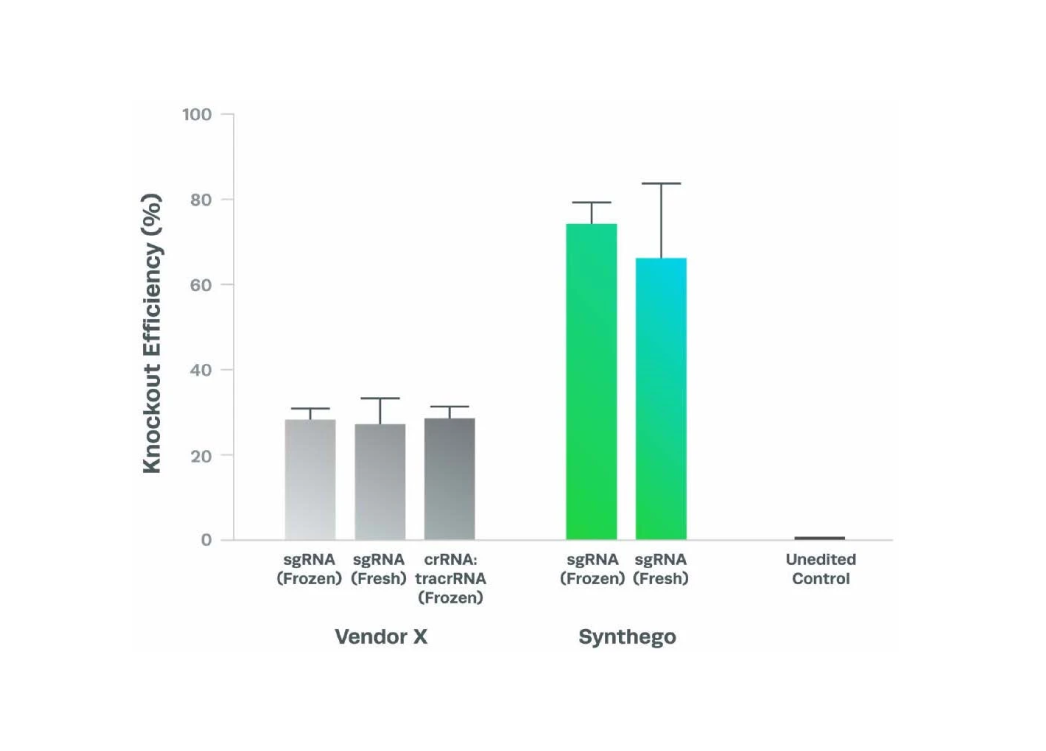
Synthego’s Research sgRNAs demonstrate superior editing efficiency compared to other vendors at the CD46 loci in resting human CD4+ T Cells. Synthego Research sgRNAs were compared against another vendor’s sgRNA and 2-part (crRNA:trRNA), demonstrating consistently high (60%+) knockout efficiency regardless of preparation conditions.

Guide RNA that Overcomes Editing Challenges

Not all cell types are easy to perform CRISPR experiments in. Certain cell types, like human resting T cells, can be challenging to achieve high editing efficiencies while maintaining high cell viability.

Image
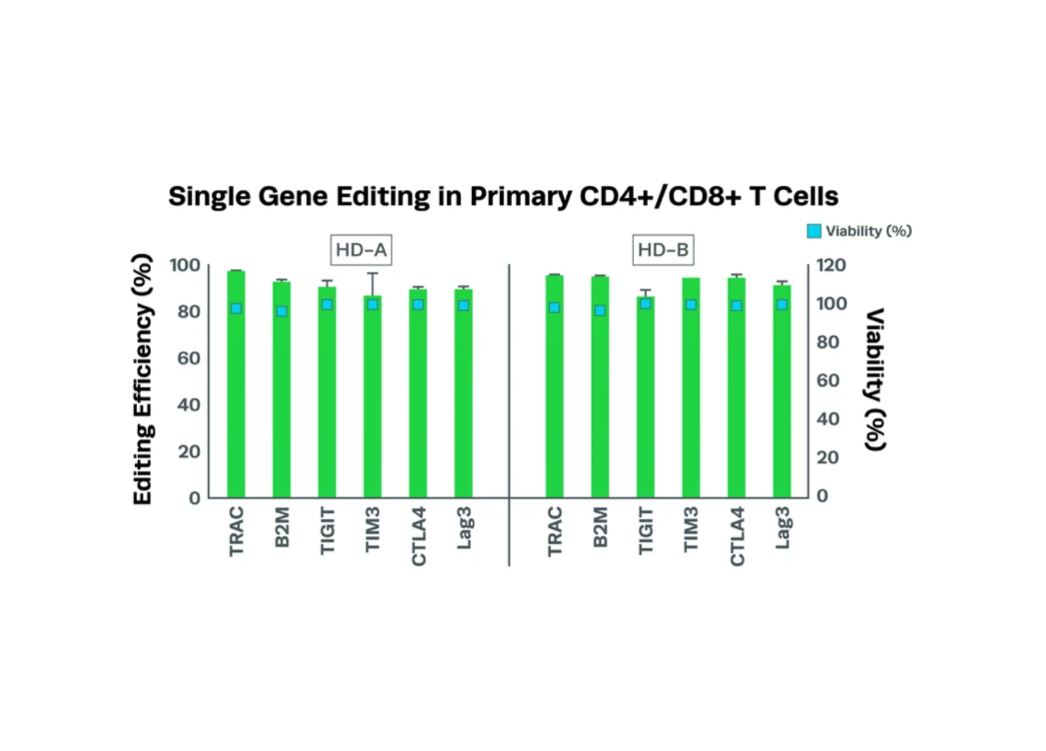
High editing efficiency and viability were observed in activated human primary T cells. Robust gene knockout is demonstrated in human primary T cell knockout using Synthego’s Research sgRNA complexed with its SpCas9 nuclease and transfected via nucleofection. High editing efficiency (>70%) of various loci was observed in activated human primary CD4+/CD8+ T cells across two independent donors (HD-A, HD-B) as assessed by sequencing analysis. Additionally, high cell viability (>95%) was consistently achieved, irrespective of editing locus, as assessed by flow cytometry.

Exceptional Editing Efficiencies without Requiring HPLC Purification

Not all chemically synthesized sgRNA are manufactured equally. During synthesis, some oligomers fail to extend during each cycle resulting in undesired truncated molecules mixed in with your desired sgRNA. Additionally, several types of chemical contaminants can be introduced through the manufacturing process of sgRNA. The presence of both these impurities can increase off-target binding, reduce on-target binding, or both. Several vendors offer high-performance liquid chromatography (HPLC) as a purification step to eliminate the unwanted truncated oligomers (n-3 to n-5) and contaminants. However, each vendor might have different synthesis and quality standards to reach the purity levels desired for your sgRNA.

Synthego’s best-in-class sgRNA can achieve exceptional editing efficiencies through standard manufacturing processes (non-HPLC) compared to HPLC purified sgRNA from other vendors. If the purity was substantially better, you would expect the HPLC purified sgRNA to perform better in all cases. However, that is not always the case in our study.

Depending on your application, particularly sensitive applications like therapeutic development require sgRNA that achieves high performance in early development and highly pure sgRNA as development progresses towards the clinic.

Image
Dose-dependent editing efficiency (mean ± SD) of Vendor T HPLC purified sgRNA (black), Synthego non-HPLC purified sgRNA (green), and Synthego HPLC purified sgRNA (blue) for gene targets a) RELA and b) CDC42BPB. HEK293 cells were transfected with RNPs of increasing molar ratio (SpCas9 constant at 10 μM) using nucleofection. Indel frequencies were analyzed via Sanger sequencing methods.
FAQ

Answers to Commonly Asked sgRNA Questions

If you have additional questions please connect with a member of our team.

Which nucleases are compatible with Synthego’s Research sgRNA?

Synthego Research sgRNAs are designed to be compatible with common CRISPR nucleases, including SpCas9, Cas12a, and many engineered high-fidelity or enhanced-specificity variants. Different sgRNA sequences and chemical modifications are tailored to the requirements of each nuclease. When selecting a gRNA, it’s important to ensure that the guide sequence and scaffold are matched to the nuclease you plan to use, as factors like PAM compatibility, cut pattern, and nuclease-specific structure can impact editing efficiency and specificity.

What yield should I choose for my experiments?
Low yields (1.5–5 nmol) are suitable for initial screens or small pilot studies.

Mid-range yields (10–30 nmol) support multi-condition optimization or extended editing workflows.

High yields (50–100+ nmol) are ideal for large-scale cell engineering, replicates, or pooled projects.

Do I need HPLC purification for my application?
Most research workflows achieve excellent performance with our standard purification, which supports high editing efficiency across cell lines and many primary cell types.
HPLC purification is recommended if you:

-Require maximum purity for sensitive applications

-Performing high-precision knock-ins

-Working with challenging delivery conditions

See our sgRNA Purity without HPLC resource for detailed data.

What are typical editing efficiencies using Research sgRNA?
Synthego Research sgRNAs deliver strong and consistent performance across a variety of cell types, including both immortalized lines and primary cells. Editing efficiency can vary depending on factors such as guide sequence, nuclease choice, and delivery method, so results may differ between experiments.

What is the benefit of including chemical modifications?
Enhanced nuclease protection: protects sgRNA from exonuclease degradation, extending its intracellular half life.

Higher editing efficiency: increased stability improves the window of active nuclease-guide complex formation.

Reduced innate immune response: modified guides limit activation of cellular immune sensors. This is critical for primary cells and therapeutic workflows.

Improved consistency: chemical stabilization reduces variability between experiments and helps maintain performance across different cell types.

Ready to get started?

Get in touch