 Cart
Cart
 Account
 Your Orders
 Sign Out
 Sign In
- ISO 13485 quality management system
- Comprehensive release testing panel
- Cell bank establishment (MCB/WCB)
- Certificate of Analysis and batch records
- Stability Studies (stress, accelerated, long-term)


Standard and custom CRISPR enzymes, aligned from IND-enabling through GMP.
Synthego provides both standard and custom CRISPR enzyme manufacturing, enabling a complete solution for gene editor components alongside our guide RNAs. From GMP-grade SpCas9 and AccuBase™ proteins to custom enzymes in mRNA or protein formats, all offerings are supported by defined quality systems, comprehensive documentation, and a scalable framework spanning IND-enabling studies through GMP applications.
Synthego is your trusted guide for your CRISPR-based therapy development. With our proven track record of successful GMP production, extensive testing and stability studies, and expert quality team to guide regulatory filings for your CRISPR-modified therapy, Synthego can help make your transition to the clinic seamless and rapid.
Synthego delivers custom CRISPR enzyme manufacturing together with guide RNAs, enabling coordinated development of gene editor components from a single partner. Custom CRISPR gene editors are available in mRNA or protein formats, and projects follow a defined, milestone-based development process with established quality controls and documentation at each stage. Two quality grades support progression from IND-enabling studies through clinical applications, with all programs initiated through a Pilot Study.
GMP-Like (INDe)
A cost-effective pathway for IND-enabling safety and toxicity studies and phase-appropriate FIH/Phase 1. Produced under ISO13485 quality management with comprehensive QC testing and full documentation.
GMP
Full regulatory compliance for clinical-stage manufacturing. Includes formal method validation, process validation, and comprehensive regulatory documentation.
GMP-grade SpCas9 and AccuBase™ proteins are manufactured under cGMP using the same enzyme designs as our RUO products. Integrated with Synthego’s sgRNA continuum, they support consistent performance and seamless progression from research through GMP applications.
Synthego’s GMP SpCas9 nuclease is engineered for exceptional ribonucleoprotein (RNP) editing efficiency. Manufactured under stringent cGMP conditions, our GMP SpCas9 ensures reliability and consistency in CGT development and clinical research.
GMP AccuBase Cytosine Base Editor delivers high efficiency and fidelity, ensuring precise genetic modifications with minimal off-target activity. Manufactured under stringent cGMP standards, AccuBase provides a safe and reliable solution for advancing clinical and commercial applications.
| Gene Editor | GMP SpCas9 Protein | GMP AccuBase Protein |
|---|---|---|
| Origin | E. coli | E. coli |
| Concentration | 10.0 mg/ml | 10.0 mg/ml |
| Fill Volume (mL) | 0.3 | 0.1 |
| Storage Buffer | 30 mM Tris, pH 7.4, 300 mM NaCl, 50% Glycerol, 0.1 mM EDTA | 30 mM Tris, pH 8.0, 300 mM NaCl, 1 mM DTT, 0.1 mM EDTA, 50% Glycerol |
| Storage | Recommended storage at -20±5°C. Avoid repeated freeze-thaw cycles | Recommended storage at -80±10°C. Avoid repeated freeze-thaw cycles |
| Stability | At storage temperature of -20±5°C, the shelf life is 18 months from the manufacturing date. | At storage temperature of -80±10°C, the shelf life is 2 years from the manufacturing date. |
| Shipping | Shipped with dry ice package and temperature sensor tracking. | Shipped with dry ice package and temperature sensor tracking. |
| GMP Gene Editors | |
|---|---|
| Regulatory Compliance | Complies with FDA and ICH cGMP regulations including Chemistry, Manufacturing and Controls (CMC) for gene editing components used in cell and gene therapies |
| Quality Management System |
ISO 13485 21 CFR part 210/211 ICH Q5, ICH Q7, ICH Q9, ICH Q10 |
| Raw Material Source |
Qualified and QA approved vendors Traceable under QMS Material Oversight by QA QC Identify Testing |
| Validated Cleaning Process | Yes |
| Manufacturing Space |
GMP suites segregated for manufacturing steps Upstream:
|
| Delivered Documentation |
Certificate of Analysis Certificate of Conformance with TSE/BSE statement |
In complement with GMP sgRNAs and nucleases, Synthego provides pre- and post-IND/IMPD regulatory expertise and support, including translating feedback from the regulatory bodies, as well as authoring the relevant gRNA CMC sections, referencing our Drug Master File (DMF) for convenient and comprehensive IND/IMPD submission.
Learn more about Synthego’s Regulatory Expertise and Support
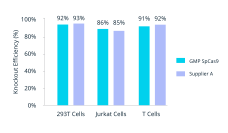
Gene knockout efficiency was analyzed in nucleofected 293T, Jurkat, and primary T cells using TIDE analysis. Results show >85% editing efficacy across all three cell types, comparable to a leading supplier.
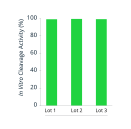
Every batch of GMP SpCas9 activity is assessed using an in vitro cleavage assay. The results indicate that the activity of three different batches (Lots 1-3) exceeds 85% and is consistent across different batches.
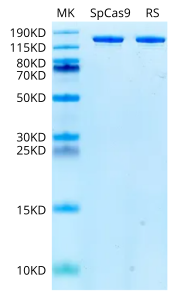
GMP SpCas9 purity assessed by Tris-Bis-PAGE against a reference standard (RS). The results indicate the purity exceeds 95%.
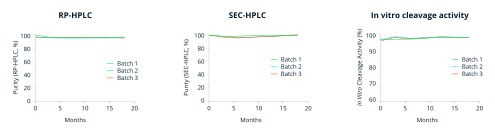
Long-term stability data (0-18 months) of three batches of GMP SpCas9 nuclease shows high stability and batch-to-batch consistency. As shown in the figure, purity remains higher than 95% (by RP-HPLC and SEC-HPLC) over 18 months. Additionally, the in vitro cleavage activity shows that the product maintains high activity over 18 months, with no obvious downward trend.