

SpCas9 nuclease protein for precise CRISPR editing
SpCas9 nuclease is a high-quality, recombinant protein that enables robust and reliable genome editing. This widely used CRISPR nuclease, complexed with a synthetic single guide RNA (sgRNA), can achieve high editing efficiencies. It features two nuclear localization signals (2NLS) to enhance its transport into the nucleus for precise gene editing.

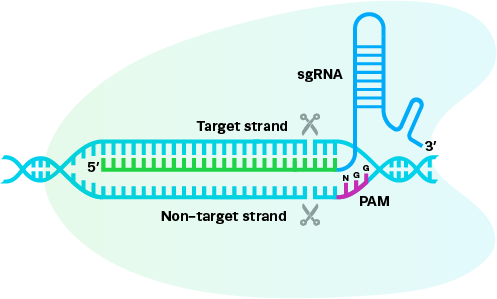
Synthego’s SpCas9 nuclease is engineered for consistent, high-efficiency editing across diverse cell types. It includes two nuclear localization signals (2NLS) to enhance nuclear delivery and is optimized for use with synthetic sgRNA. When paired with Synthego’s Research sgRNA, SpCas9 generates precise blunt-end double-strand breaks approximately three nucleotides upstream of the 5′-NGG-3′ PAM sequence, enabling reproducible editing outcomes and streamlined optimization across applications.
| Product Number | R20SPCAS9 |
| Intended Use | This product is intended for research use only |
| Shipping Conditions | Cold Pack |
| Source | E. coli |
| Purity | ≥ 95% |
| Molecular Weight | 163 kDa |
| Concentration | 10 mg/mL |
| Volume | 10 µL 50 µL 100 µL 500 µL |
| Delivery Format | Tubes |
| Function | Catalyzes site-specific double-stranded DNA cleavage guided by a single guide RNA (sgRNA) to facilitate targeted genome engineering in eukaryotic cells. |
| For Use In | CRISPR-Cas9 gene editing experiments with recombinant protein nuclease |
| Storage Temperature | -20°C |
| Buffer Composition | 25-30 mM Tris-HCl*, 300 mM NaCl, 1 mM DTT, 0.1 mM EDTA, 50% Glycerol, pH 7.6 |
| Specification | SpCas9 |
|---|---|
| Size | 1368 amino acids |
| PAM Sequence (N = any nucleotide) | 5'-NGG-3’ |
| DNA Cleavage | Blunt end cut 3nt upstream of PAM sequence |
| Endonuclease Domains | HNH and RuvC |
| gRNA Length | 97 - 103nt |
| Target Sequence Length | 20 nt |
| Enzyme Class | Type IIa CRISPR-Cas system of Streptococcus pyogenes Cas9 |
For designing SpCas9 guide RNA(s), use your favorite guide design platform and select SpCas9 nuclease, which has a 5'-NGG PAM sequence.
After you design your SpCas9 guide RNA, use our easy-to-use order interface to order your guides. We will synthesize them resulting in high-quality synthetic guide RNA you complex with our SpCas9 nuclease to achieve your highest editing efficiency.
The following modifications are included on our SpCas9 sgRNA during synthesis:
2'-O-Methyl at 3 first and last bases, 3' phosphorothioate bonds between first 3 and last 2 bases
Synthego’s SpCas9 nuclease is engineered to deliver consistent, high editing efficiency, helping streamline CRISPR optimization and reduce experimental variability. Its reliable performance supports efficient target editing and enables smooth progression from early research through downstream functional assays.

Our SpCas9 nuclease supports efficient, scalable genome editing across large, high-throughput screening campaigns. Its reliable performance supports efficient target editing and enables smooth progression from early research through downstream functional assays.

If you have additional questions please connect with a member of our team.
Electroporation/nucleofection (most common)
Microinjection
Lipid-based delivery systems
Learn more about CRISPR delivery methods.
 Cart
Cart
 Account
 Your Orders
 Sign Out
 Sign In