 Cart
Cart
 Account
 Your Orders
 Sign Out
 Sign In
Consistent manufacturing and documentation strategies that support seamless progression from early discovery to regulated workflows.
→

Your CRISPR success starts with Synthego, where our proven expertise goes beyond delivering best-in-class gRNAs to providing cutting-edge CRISPR gene editors. With a successful track record in synthesizing and optimizing gRNAs, Synthego is dedicated to equipping you with high-performance nucleases and base editors precisely paired with engineered gRNAs to meet your most challenging CRISPR objectives. Whether you’re aiming to enhance your research efficiency or drive your therapeutic breakthroughs toward commercialization, Synthego is here to help you turn your breakthrough discoveries into impactful clinical applications.
CRISPR editing outcomes are shaped by delivery format. Nucleases can be introduced as mRNA or protein, each offering distinct advantages depending on your workflow, cell type, and application needs.

Engineered Cas9 protein optimized for improved specificity and controlled editing activity

High-fidelity Cas12 nuclease protein with expanded targeting and improved precision

Standard SpCas9 protein for high-efficiency editing with immediate activity
Engineered Cas9 mRNA designed for high-specificity editing with tunable expression
High-fidelity Cas12 mRNA enabling precise editing with access to broader genomic targets
Standard SpCas9 mRNA enabling reliable, scalable gene editing across workflows
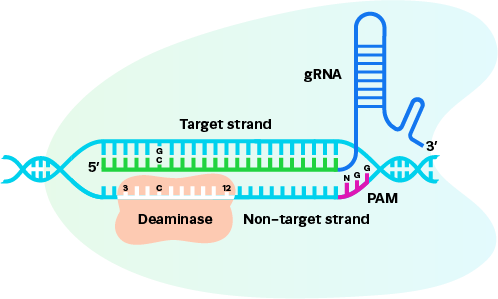
Extend your gene editing capabilities with advanced approaches. Base editing and GMP-grade solutions enable targeted modifications and support workflows aligned with translational and therapeutic development.

Engineered cytosine base editor designed for therapeutic applications. It enables precise single base conversions from C to T, minimizing off-target activity and eliminating the risk of double-strand breaks.

GMP SpCas9 and GMP AccuBase CBE are engineered for exceptional RNP editing efficiency. Manufactured under stringent cGMP conditions and compliance with the FDA and ICH GMP regulations.

From nuclease selection to base editing to translational scale-up, our integrated CRISPR solutions are designed to help you achieve precise, efficient, and scalable genome editing outcomes across every stage of development.
Consistent manufacturing and documentation strategies that support seamless progression from early discovery to regulated workflows.
→
Work with a team experienced in gRNA optimization, editor pairing, and workflow integration to accelerate program success.
→
Engineered for high on-target activity and reduced off-target effects across diverse research and therapeutic applications.
→
Access novel nucleases and base editors with licensing models designed to support long-term clinical and commercial development.
→
CRISPR gene editing performance starts with selecting the right delivery format. Nucleases can be introduced as either mRNA or protein, each offering distinct advantages depending on your workflow, cell type, and experimental goals. While both formats enable efficient genome editing, differences in activity timing, persistence, and scalability can significantly impact outcomes.
Use the comparison below to determine the best fit for your application.
mRNA |
Protein |
||
|---|---|---|---|
| How it Works | Delivered as mRNA and translated into the cell into active nuclease before editing begins | Delivered as a pre-formed ribonucleoprotein complex, enabling editing immediately upon entry | |
| Onset & Duration | Delayed onset due to translation, with moderate, sustained activity depending on mRNA stability | Immediate activity with a short, tightly controlled window due to rapid protein degradation | |
| Control & Specificity | Controlled via expression kinetics; longer presence may increase exposure time | High temporal control with rapid clearance, helping minimize off-target effects | |
| Workflow & Handling | Simplified workflow, compatible with scalable, enzymatic synthesis | Flexible delivery, durable storage considerations | |
| Scalability & Manufacturing | Highly scalable, enzymatic, cell-free production aligned with modern biologics workflows | Highly scalable, dependent on recombinant protein production and purification | |
| Best Fit Application | High-throughput screening, Primary cells, in vivo editing, early-stage research, and workflows requiring scale and flexibility | High-throughput screening, Primary cells, ex vivo editing, and applications requiring precision and tight control |
CRISPR delivery formats offer distinct advantages depending on your workflow priorities — whether you need rapid, transient activity or scalable, flexible expression. Understanding these differences enables more confident decision-making and better experimental outcomes.
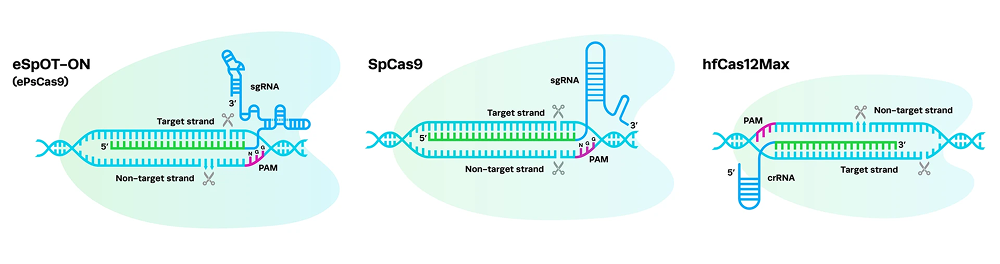
Once you’ve selected your preferred format, the next step is choosing the optimal nuclease for your application. Different CRISPR nucleases offer unique capabilities in terms of targeting range, specificity, and editing mechanism.
Use the comparison below to determine the best fit for your application.
eSpOT-ON |
SpCas9 |
hfCas12Max |
|
|---|---|---|---|
| Size | 1409 amino acids | 1368 amino acids | 1080 amino acids |
| Pam Sequence (N = any nucleotide) | 5'-NGG-3' PAM is 3' of the target DNA sequence |
5'-NGG-3' PAM is 3' of the target DNA sequence |
5'-TN-3' or 5'-TTN-3 |
| DNA Ccleavage | Staggered-cut Cleavage on the target strand occurs 3 nt upstream of the PAM, while the non-target strand is cut 6-7 nt upstream of the PAM |
Blunt end cut Cleavage 3 nt upstream of PAM sequence |
Staggered-cut Cleavage on the target strand occurs 24 nt downstream from PAM, while the non-targeted strand is cut 14-16 nt downstream. |
| Endonuclease Domain | HNH and RuvC | HNH and RuvC | RuvC |
| Full Length gRNA | 109 nt | 97 - 103 nt | 44 - 50 nt |
| Target Sequence | 22 nt | 20 nt | 20 nt |
| gRNA Components | crRNA + tracrRNA as a single guide RNA (sgRNA) | crRNA + tracrRNA as a single guide RNA (sgRNA) | crRNA |
| Origin | Engineered from Parasutterella secunda Cas9 (PsCas9) | Streptococcus pyogenes Cas9 (SpCas9) | Engineered from Cas12i |
| CRISPR Enzyme Class | Type IIb CRISPR-Cas system of Parasutterella secunda Cas9 | Type IIa CRISPR-Cas system of Streptococcus pyogenes Cas9 | Type V CRISPR-Cas system of Cas12 |
| Licensing Association | AstraZeneca | N/A | Huidagene |
CRISPR nucleases form a versatile toolbox, each designed to address specific editing challenges — whether you need a well-characterized standard, enhanced precision, or expanded genomic targeting. Understanding these differences enables more confident decision-making and better experimental outcomes.
Selecting the right CRISPR format and nuclease is critical to achieving reliable, high-quality editing outcomes. Whether you're optimizing for precision, scalability, or workflow simplicity, Synthego’s experts are here to help you navigate your options and identify the best path forward for your application.