 Cart
Cart
 Account
 Your Orders
 Sign In
Due to their length, not all pegRNAs are amenable to chemical synthesis. For these pegRNAs, in vitro transcription with T7 RNA Polymerase may be a good alternative.

CRISPR has many applications beyond the standard knock-out and knock-in edits! Here, we provide gRNA design suggestions for other CRISPR gene editing approaches.
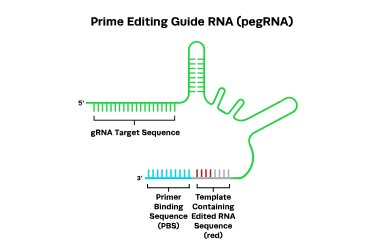
PE uses a nuclease-reverse transcriptase fusion protein and a unique prime editing gRNA (pegRNA) to introduce a range of edit types, including knock-ins and single-base changes. If you’d like to learn more about PE, we recommend this article as a starting point.
PE is unique among CRISPR editing methods because the gRNA determines the edit site and encodes the desired repair. Given the complexity of the pegRNA, we recommend using a specialized design tool like PE-Designer or the Prime Editing Design Tool to simplify your design process.
When designing and optimizing pegRNAs for your experiment, we recommend considering the following parameters (Anzalone et al.).
Due to their length, not all pegRNAs are amenable to chemical synthesis. For these pegRNAs, in vitro transcription with T7 RNA Polymerase may be a good alternative.
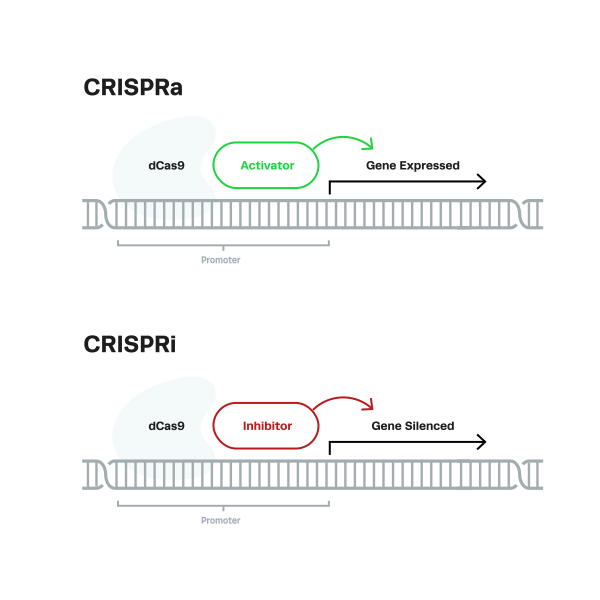
CRISPRa and CRISPRi are non-editing applications of CRISPR technology. Instead, a catalytically inactive Cas nuclease, or dead Cas (dCas), is fused to a transcriptional effector that promotes (CRISPRa) or represses (CRISPRi) transcription. If you’d like to learn more about CRISPRa/CRISPRi, we recommend our comprehensive guide to CRISPR methods and this introduction to CRISPRa/i.
For CRISPRa and CRISPRi experiments, you must design gRNAs that target the promoter region of your gene of interest. This type of design can be facilitated by a specialized design tool, like CRISPR-ERA or CRISPick, which suggests designs based on the annotated start site of your gene. Other design tools, like Benchling, can also work well for CRISPRa/CRISPRi gRNA design, though you may need to manually identify the target region (promoter).
Introducing two or more gRNAs into your target cells simultaneously can result in the excision (deletion) of the genomic fragment between the cut sites.
In CRISPR experiments involving two or more gRNAs, the frequency of specific fragment deletions depends on a number of factors, including gRNA spacing. Cut sites separated by larger distances are more likely to yield indels at each cut site versus the deletion of the sequence between the cut sites. While fragment deletions of >1 kb in size are possible, a 2020 study demonstrated that gRNA spacing of 45-300 bp was most likely to result in synergistic editing. For smaller fragment deletions, we advise selecting gRNAs that do not overlap because they may compete with one another.
Most CRISPR gRNA design tools can be used to identify gRNAs for fragment deletion edits. For this edit type, we recommend using a tool like Benchling that allows you to visualize the relative position of each gRNA within the genomic region you plan to target.
Once you are ready to order your gRNAs, you can access our ordering page here.
For a comprehensive guide to Synthego’s CRISPR resources, please visit our Getting Started with CRISPR page.