Learn more Webcast featuring eSpOT-ON
Explore More eSpOT-ON Nuclease Protein Available Now
Explore More Order eSpOT-ON Nuclease mRNA Now
TECHNICAL SUPPORT

Ordering gRNAs

Thank you for choosing Synthego’s best-in-class gRNAs for your CRISPR experiments! Our gRNA ordering page allows you to enter and customize gRNA sequences for a broad range of applications. Here, we discuss each field you will complete to order your gRNAs.

Menu: Gene Editor

To order gRNAs for your CRISPR experiment, you must first select your Gene Editor. 

Synthego offers five Gene Editor options: 

  1. eSpOT-ON
  2. hfCas12Max
  3. AccuBase™
  4. SpCas9
  5. Other Gene Editor

Note: eSpOT-ON is offered in recombinant protein or mRNA format.

If you select eSpOT-ON, hfCas12Max, or AccuBase, we will automatically add the optimized scaffold sequence and standard chemical modifications for your selection. You will provide your target sequence only. 

When selecting SpCas9, you will choose between two modification options: unmodified or standard. For both unmodified molecules or molecules with standard modifications, the molecule's constant or scaffold region and modification patterns will be pre-determined. You will only provide your target-specific sequence.

Each gRNA includes a gene editor-specific sequence domain (scaffold sequence) that allows the gRNA to complex with a specific CRISPR enzyme. If you have questions about our optimized scaffold sequences for eSpOT-ON, hfCas12Max, AccuBase, or SpCas9, please contact our technical support team.

If your gRNA is intended for use with Other Gene Editors, including all novel or engineered CRISPR enzymes, you must provide the full-length sequence. The full-length sequence includes the target-specific sequence and the scaffold sequence in the 5’ to 3’ orientation, excluding the PAM. 

If you plan to order gRNAs for an alternative gene editor but are uncertain about the full-length sequence, please contact our technical support team for guidance.

Menu: Modifications

Synthego offers three modification patterns through our online ordering page. For a detailed discussion of the purpose and function of chemical modifications, please visit our Demystifying CRISPR gRNA Chemical Modifications blog. 

  1. Standard Modifications: Synthego’s standard modifications consist of 5’ and 3’ end-modifications (2’-O-methyl analogs and 3’ phosphorothioate bonds) in a pattern optimized for your Gene Editor selection. If you select Other Gene Editor, you may apply Synthego’s standard modifications; however, please note that this modification pattern has not been tested for all gene editors and may not be optimal for your system. For a detailed breakdown of the standard modifications used with each of our gene editors, please see Table 1 below. 
  2. User-defined Modifications:This option is suited for custom modification patterns. The researcher provides the full-length gRNA sequence with 2'-O-methyl base analog and 3' phosphorothioate bonds at the desired locations. Guidance for entering your custom modifications may be found in the Sequence section below.
  3. Unmodified: gRNAs without modifications have the chemical structure of native RNA.

If you are unsure which modification patterns are appropriate for your CRISPR enzyme, please contact our technical support team for guidance.

Table 1. Synthego’s Standard Modifications

CRISPR Enzyme
Synthego's standard chemical modification pattern
eSpOT-ON
2'-O-Methyl analogs at the first 3 and last 3 bases. 3' phosphorothioate bonds at the first 3 and last 3 bond positions.
hfCas12Max
2'-O-Methyl analog at the first 3 bases. Of the last 4 bases, 3 are 2'-O-Methyl analogs, and the last base is unmodified. 3' phosphorothioate bonds at the first and last 3 bond positions.
AccuBase
2'-O-Methyl analogs at the first 3 and last 3 bases. 3' phosphorothioate bonds at the first 3 and last 2 bond positions.
SpCas9
2'-O-Methyl analogs at the first 3 and last 3 bases. 3' phosphorothioate bonds at the first 3 and last 2 bond positions.
Other Gene Editor*
2'-O-Methyl analogs at the first 3 and last 3 bases. 3' phosphorothioate bonds at the first 3 and last 2 bond positions.
Sequence Field

The contents of this field will be determined by your selections in the Gene Editor and Modifications menus. Based on these selections, the Sequence field will guide you to enter the target sequence, full-length sequence, or full-length sequence with modifications.

Regardless of your sequence entry type, Synthego will synthesize your sequence as entered. Please confirm that your sequence is correct and complete before ordering. Sequences should be entered in 5’ to 3’ orientation, excluding the PAM sequence.

Target Sequence

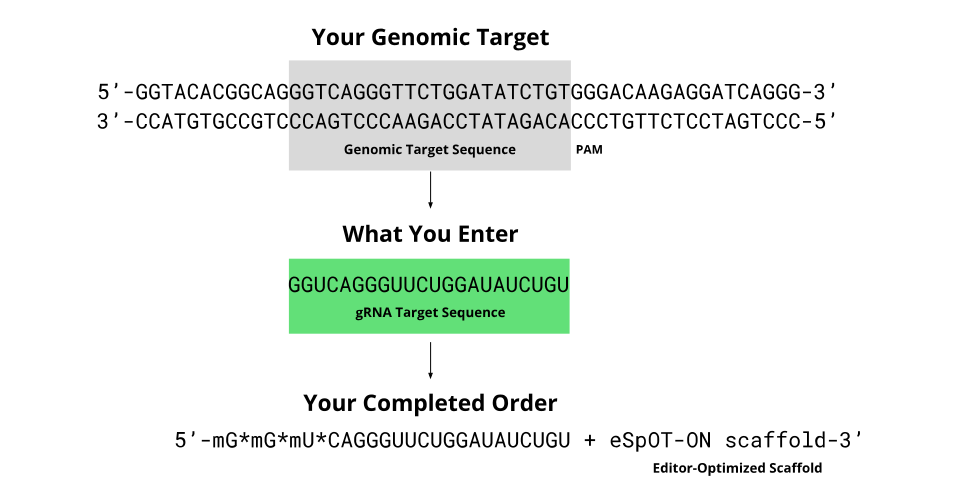
If you select eSpOT-ON, hfCas12Max, AccuBase, or SpCas9 (unmodified or standard modification only), you will provide the ~20 base targeting sequence only. We will automatically synthesize your target sequence attached to a constant or scaffold sequence optimized for the selected Gene Editor. We will also automatically include standard modifications, unless you select SpCas9 from the Gene Editor menu and Unmodified from the Modifications menu.

Example
This example shows the entry of an eSpOT-ON gRNA. The researcher provides the target sequence only. Synthego appends the optimized scaffold and chemical modifications at the time of production.

Note: The synthesized sequence will include the standard modifications for the Gene Editor (if applicable) and Synthego’s predetermined proprietary scaffold sequence for the Gene Editor. The 89-nucleotide eSpOT-ON scaffold sequence is represented here using placeholder text (“eSpOT-ON scaffold”).

ImageThis example shows the entry of an eSpOT-ON gRNA. The researcher provides the target sequence only. Synthego appends the optimized scaffold and chemical modifications at the time of production.

Full-Length Sequence

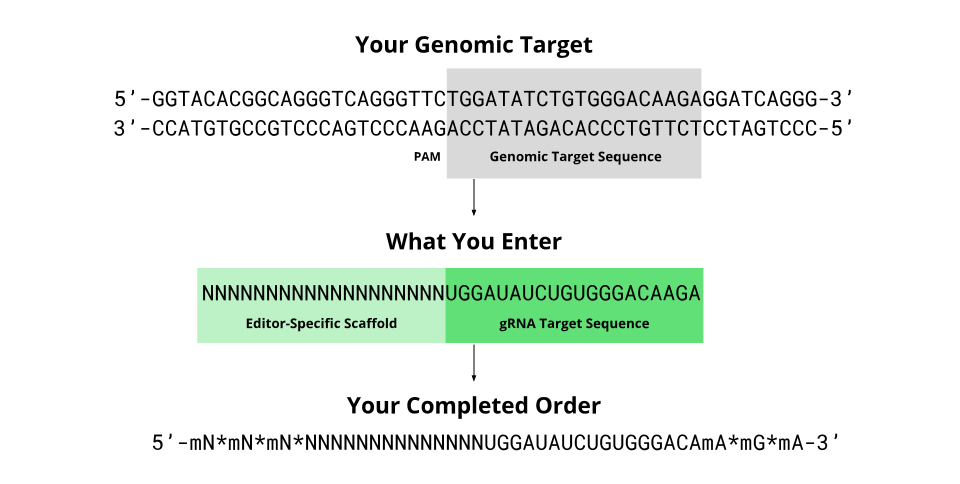
If you select Other Gene Editor (unmodified or standard modifications), you must provide the entire sequence of your gRNA molecule (target plus scaffold sequence). If you select standard modifications, they will be automatically added during synthesis.

Example
This example depicts the entry of a hypothetical novel Cas12 variant gRNA sequence with Synthego’s standard modifications. While we have included non-specified bases (N) in this example, full-length sequences must specify the base used at each position. Additionally, the scaffold sequence precedes the targeting sequence in this example. The relative orientation of the target and scaffold sequence will vary depending on your nuclease. If you have questions about the appropriate assembly of your gRNA, please contact our technical support team for guidance.

Note: The synthesized sequence will include the standard modifications for the Gene Editor (if applicable).

This example depicts the entry of a hypothetical novel Cas12 variant gRNA sequence with Synthego’s standard modifications.

Full-Length Sequence With Modifications Indicated in Sequence

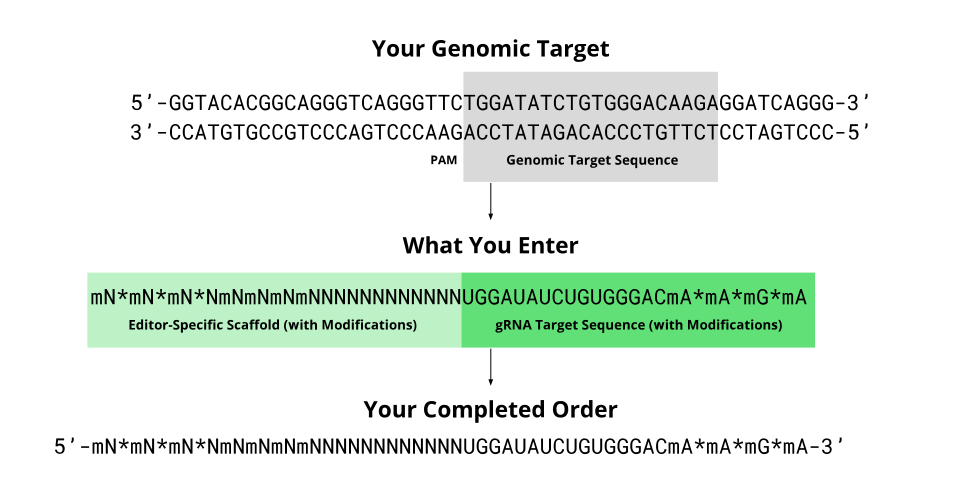
If you select SpCas9 or Other Gene Editor and select User-Defined from the modifications menu, you must enter the full-length sequence of your gRNA molecule with 2’-O-methyl analogs and 3’ phosphorothioate linkages at the desired locations. 

  1. 2’-O-methyl analogs: To indicate a base with a 2’-O-methyl analog, place an m in front of the base you wish to modify (e.g., mG). 
  2. 3’ phosphorothioate linkages: To indicate a 3’ phosphorothioate linkage, place a * between the bases you wish to have the bond (e.g., G*G or mG*mG or G*mG or mG*G). 

If you are interested in chemical modifications beyond 2’-O-methyl analogs and 3’ phosphorothioate bonds, please contact our technical support team for guidance.

Example
This example depicts the entry of a hypothetical novel Cas12 variant gRNA sequence decorated with a custom modification pattern. While we have used non-specified bases (N) for this example, full-length sequences must specify the base used at each position. Additionally, the scaffold sequence precedes the targeting sequence in this example. The relative orientation of the target and scaffold sequence will vary depending on your nuclease. If you have questions about the appropriate assembly of your gRNA, please contact our technical support team for guidance.

This example depicts the entry of a hypothetical novel Cas12 variant gRNA sequence decorated with a custom modification pattern.

Avoiding Common Entry Errors

It is critical to ensure that your molecules are entered correctly into our system to ensure that you get the RNA molecules you need for your experiments. Below, we’ve described common errors for each sequence entry type and how to avoid them.

All sequence entry types

  • Do not use a non-single-letter convention to enter your sequences (e.g., rArCrGrU…).
    • Please indicate the bases in your sequence using only RNA (ACGU) or DNA (ACGT) codes.
  • Do not enter a mix of RNA and DNA bases.
    • Use all RNA bases (ACGU) or DNA bases (ACGT). If using DNA code to enter your gRNA sequences, you must click the ‘Convert to RNA’ button before adding your sequencing to your cart.
  • Do not include the PAM sequence in your target sequence.
    • The PAM sequence is never part of the gRNA. If the PAM sequence is included in your target or full-length sequence, we will synthesize the sequence as entered and include the PAM bases in your molecule. gRNAs that include the PAM sequence are nonfunctional.
  • Do not enter the reverse complement, reverse, or complement of your gRNA sequence.
    • Please enter the sequence as you would like it synthesized in 5’ to 3’ orientation. We will not synthesize the reverse complement, reverse, or complement of the sequence provided. If you provide your sequence using DNA code, we will convert this sequence to RNA code without making any other changes (e.g., CAT will become CAU).

Target sequence entry

  • Do not include the PAM sequence in your target sequence.
    • The PAM sequence is never part of the gRNA sequence. Please only enter the target sequence without the PAM.
  • Avoid entering an incomplete target sequence or additional non-target sequence.
    • Most target sequences are approximately 20 bases long, though this may vary depending on the gene editor used. If your sequence is too short or too long, an error will occur, and you’ll need to adjust the length.

Full-length sequence entry

  • Do not enter an incomplete sequence.
    • Full-length sequences are synthesized exactly as entered, with no additions or changes. Thus, you must provide the targeting and scaffold sequence for your molecule.

Full-length sequence with modifications entry

  • Avoid entering modifications in the incorrect position relative to the modified bases.
    • m (2’-O-methyl analog) must be a prefix to any modified bases.
    • * (3’ phosphorothioate linkages) must be located at linkage positions between bases.
  • Do not enter modification characters other than m (2’-O-methyl analog) and * (3’ phosphorothioate).
    • Synthego’s online ordering page does not support other modification types at this time. If you would like to include other modifications, please contact our sales team.

Yield

Synthego offers a range of yield options suitable for discovery-phase research through our online ordering page.

If you are interested in additional yield options, please contact our sales team.

Your purification and format options may depend on the yield of material you need for your experiments.

Purification

Synthego offers two purification grades: standard purification and HPLC purification.

Standard Purification

Synthego’s standard purification is suitable for most discovery research applications. To purify all gRNAs, Synthego uses solid phase extraction (SPE) to enrich for your full-length gRNA sequences. For some larger yield orders, Synthego automatically adds size exclusion chromatography (SEC) for additional desalting.

HPLC Purification

HPLC purification is available for researchers who require additional purification steps. HPLC purification removes production contaminants, including sequence contaminants, that may not be completely removed by our standard purification. Please be aware that HPLC purification is available for a subset of yields only. If you are interested in HPLC-purified molecules, please contact our sales team. 

For researchers interested in additional analytical data, Analytical HPLC Reports are available for HPLC-purified molecules. If you want to add analytical HPLC to your gRNA order, please contact our sales team. 

Format

Synthego offers gRNAs in tubed and plated formats. Plated formats are available for orders including 24 or more gRNAs.

We recommend carefully mapping your experiment before committing to a format. Plated gRNAs are useful if you plan to perform high-throughput editing experiments or use a liquid handling system. Tubed gRNAs provide greater flexibility for lower-throughput experiments or manual workflows.

What's Next?

When your order is booked, we will provide an estimated shipment date. We make each gRNA to order, and our production timelines reflect the time it takes to synthesize and prepare your molecules for shipment. If you have specific deadlines, please contact your sales representative before placing your order. The earlier we know about your specific time constraints, the greater our ability to work with you to meet these needs! 

Once your order is shipped, you will receive a shipment notification email with your tracking details. 

While you wait for your gRNAs to arrive, we recommend reviewing our Synthetic gRNA User Guide and the protocols available through our Resources page.

Additional Assistance

Having trouble with your gRNA designs? Connect with our scientific support team!

Contact Support
