Learn more Webcast featuring eSpOT-ON
Explore More eSpOT-ON Nuclease Protein Available Now
Explore More Order eSpOT-ON Nuclease mRNA Now

Cell-Free Protein Expression

Welcome to the future of protein research! Cell-free protein expression is transforming the way scientists produce proteins, offering unmatched speed, flexibility, and precision. Whether you’re screening proteins, producing challenging targets, or scaling up for structural studies, our E. coli Cell-Free Protein Expression Kits are designed to meet your needs.

What is Cell-Free Protein Expression?

Cell-free protein expression is an innovative method for synthesizing proteins without the need for living cells. It uses a prepared mixture of cellular components—like ribosomes, enzymes, and energy sources—to replicate the natural protein synthesis process in a controlled environment. This eliminates the time-consuming steps of cell culture, offering faster, more flexible, and controllable protein production.
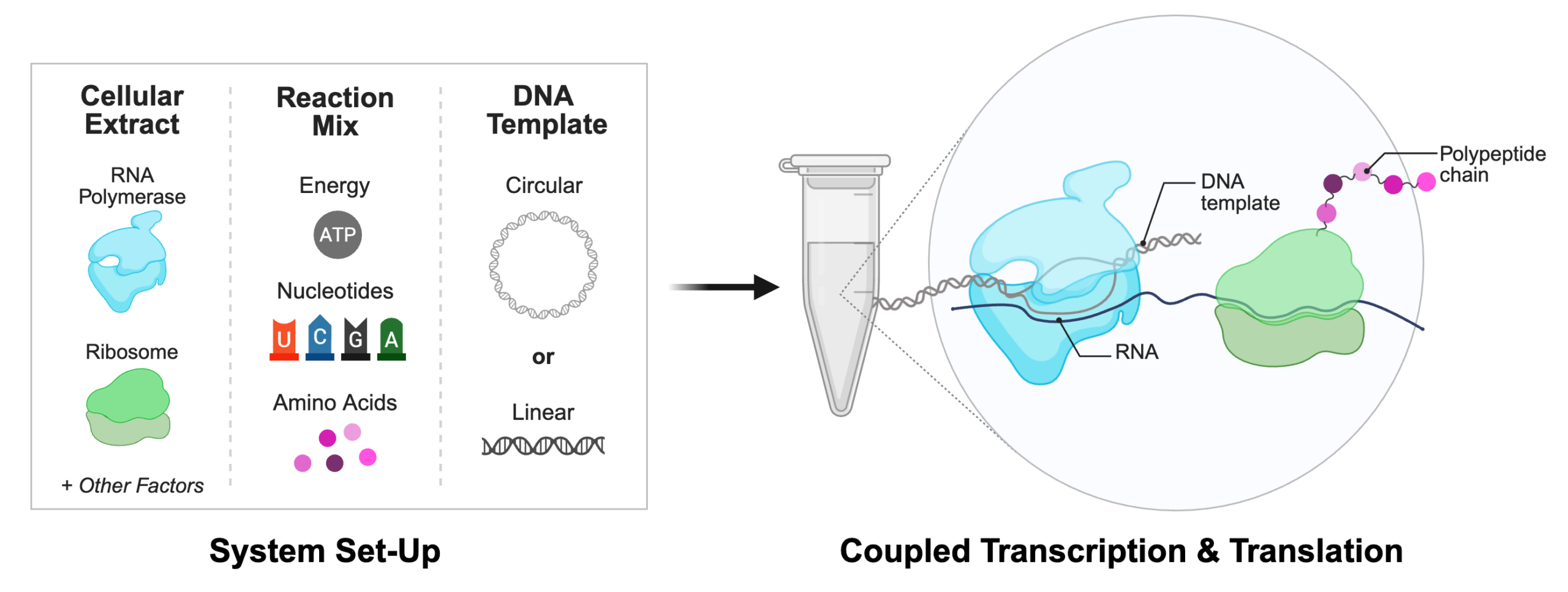
The process involves four key steps:

Extract Preparation: Extract cellular components like ribosomes and enzymes from organisms like E. coli.

Reaction Setup: Combine extract with DNA/RNA templates and energy sources.

Supplementation: Add labeled amino acids or optimize conditions as needed.

Protein Synthesis: Translate genetic information into proteins.

Why Choose Cell-Free Over Cell-Based Expression?

Cell-free systems offer several key advantages over traditional cell-based methods:

  • Faster Results: Express proteins in hours, not days to weeks.
  • Improved Protein Expression: Produce challenging membrane or toxic proteins with ease.
  • Flexibility: Incorporate labeled amino acids, use linear DNA or plasmids, and optimize conditions effortlessly.
  • Simplified Workflow: Skip transformations, optimizing cell viability, and screening cultures.
  • Scalability: Ideal for both small-scale screening and medium-scale production.

With cell-free protein expression, you can tackle even the most challenging research projects with speed and precision, achieving high purity and high yield by eliminating contaminating cellular byproducts and cell toxicity.

Ready to get started with Synthego's Cell-Free Protein Expression Kits?

With cell-free protein expression, you can tackle even the most challenging research projects with speed and precision.
Explore Our Cell-Free Kits
CTA Image

Methods and Protocols for Cell-Free Expression

Understanding how to perform cell-free protein expression is straightforward, as the protocol is designed to simplify workflows while delivering high-quality results. This method is applicable across various systems and applications, ensuring flexibility and adaptability for researchers.

General Protocol

Follow these steps to get started with cell-free protein expression:

  1. Prepare Your DNA Template: Use either linear DNA (PCR-generated) or plasmid templates. Ensure the template includes regulatory elements like the promoter, ribosomal binding site, and terminator.
  2. Set Up the Reaction: Combine the cell extract, DNA template, reaction buffer, and any additional components (e.g., labeled amino acids) in the reaction chamber.
  3. Incubate at a Constant Temperature: Place the reaction at the recommended temperature (typically 30°C) for 4–24 hours, depending on the kit and desired yield.
  4. Detect the Desired Protein: Analyze the results using SDS-PAGE, Western blot, or other methods to confirm protein expression and purity.

For Rapid Screening and Optimization

Rapid screening and optimization are essential for testing multiple expression constructs, identifying the best conditions for protein production, and troubleshooting challenging targets. Variables such as template design, reaction conditions, and buffer composition are often screened to maximize yield and solubility.

  • Design Multiple Templates: Create linear DNA or plasmid templates with variations in regulatory elements or coding sequences.
  • Set Up Parallel Reactions: Use small-scale reactions (e.g., 50 µl) to test multiple conditions simultaneously.
  • Optimize Conditions: Adjust variables like magnesium concentration, reaction time, or temperature to identify the best conditions for your target protein.
  • Analyze Results: Evaluate yield, solubility, and activity of the expressed proteins to determine the optimal setup.

Synthego's E. coli Cell-Free Protein Expression Kit

  • Produces up to 20 µg of protein in just 4 hours.
  • Compatible with both linear DNA templates and plasmids.
  • Ideal for rapid testing and optimization of expression constructs.

End Deliverable: Up to 20 µg of functionally active protein with high yield and purity, ready for further analysis or downstream applications.
For Medium-Scale Protein Production

Medium-scale protein production is ideal for applications requiring larger quantities of protein, such as structural biology (e.g., NMR spectroscopy, X-ray crystallography) or functional assays. This approach allows researchers to optimize reaction conditions for maximum yield and purity while scaling up from smaller screening experiments.

  1. Prepare Plasmid Template: Use circular DNA templates optimized for high-yield expression.
  2. Set Up the Reaction: Use a larger reaction volume (e.g., 1 ml) with a continuous exchange system to sustain protein synthesis.
  3. Optimize Reaction Conditions: Adjust variables like feeding solution composition, reaction time, and temperature to maximize yield.
  4. Analyze Protein: Collect the expressed protein, evaluate yield and purity, and prepare for downstream applications.

Synthego's E. coli High-Yield Cell-Free Protein Expression Kit

  • Produces up to 6 mg of protein in 24 hours.
  • Compatible with circular DNA templates.
  • Utilizes Continuous Exchange Cell-Free (CECF) technology for sustained reactions.
  • Allows incorporation of labeled amino acids for structural studies.

End Deliverable: Up to 6 mg of high-purity protein, suitable for structural studies or functional assays.

CECF Explained:

The Continuous Exchange Cell-Free (CECF) principle uses two semi-permeable membranes to exchange substrates and byproducts between a 1 ml reaction chamber and a 10 ml feeding chamber. This system continuously supplies essential components (e.g., energy, nucleotides, amino acids) while removing inhibitory byproducts, enabling protein expression to continue for up to 24 hours. Without this technology, reactions would stop prematurely due to depletion of substrates or accumulation of byproducts.

Incorporation of Labeled Amino Acids

In traditional in vivo systems, incorporating labeled amino acids like selenomethionine or isotopically labeled amino acids (e.g., 15N or 13C) can be challenging. These systems often result in incomplete incorporation due to metabolic processes or contamination with naturally occurring amino acids. This can lead to variability in molecular weight and labeling efficiency, complicating downstream applications like crystallization or NMR studies.

How Does It Work?

The E. coli High-Yield Cell-Free Protein Expression Kit is uniquely designed to facilitate labeled amino acid incorporation. By separating amino acids from other reaction components, the system allows researchers to easily swap in labeled amino acids without disrupting the reaction. This flexibility ensures that your proteins are labeled exactly as needed for your experiments.

With our cell-free system, amino acids are supplied separately from other reaction components, allowing:

  • Complete Control: Precisely substitute methionine with selenomethionine or selectively incorporate isotopically labeled amino acids.
  • Reduced Waste: Use smaller amounts of expensive labeled amino acids compared to in vivo systems.
  • Custom Labeling: Achieve uniform labeling or selectively incorporate single labeled amino acids.

Note: Labeled amino acids are not included in the kit but are readily available from several suppliers in crystalline form.

Addition of Supplements

Producing functional proteins often requires more than just the basic components of a cell-free system. Depending on the nature of your target protein, adding supplements like detergents, stabilizers, or chaperones can significantly improve yield, solubility, and functionality. Without these supplements, proteins may aggregate, lose activity, or fail to achieve their native conformation. Adding supplements can:

  • Enhance Solubility: Prevent aggregation and improve protein stability with detergents and stabilizers like CHAPS, Brij35, and Sorbitol.
  • Promote Proper Folding: Facilitate proper folding with chaperones like DnaK and GroE.
  • Enable Membrane Protein Expression: Solubilize membrane proteins with detergents like CHAPS and DDM.

How Does It Work?

The E. coli High-Yield Cell-Free Protein Expression Kit is designed to allow the addition of supplements without disrupting the reaction. You can add:

  • Up to 200 ul of supplement solution directly to the reaction chamber.
  • Up to 2 ml of supplement solution to the feeding chamber for sustained delivery during the reaction.

To determine the best supplement conditions for your protein, we recommend starting with small-scale reactions using the E. coli Cell-Free Protein Expression Kit. Once optimal conditions are identified, they can be scaled up to the High-Yield Kit for larger reactions.

Frequently Asked Questions

What is cell-free protein expression?
Cell-free protein expression is a method of synthesizing proteins in a controlled, cell-free environment using a mixture of cellular components like ribosomes, enzymes, and energy sources. Unlike traditional methods that rely on living cells, this system bypasses the need for cell culture, allowing proteins to be produced directly in a reaction chamber. This approach is faster, more flexible, and ideal for producing proteins that are toxic to cells or difficult to express in vivo.

What types of proteins can be expressed using cell-free systems?
Cell-free systems can express a wide variety of proteins, including soluble proteins, membrane proteins, and toxic proteins. Soluble proteins are straightforward to produce, while membrane proteins can be stabilized with the addition of detergents. Toxic proteins, which often kill host cells in traditional systems, can be expressed without issue in cell-free systems because there are no living cells to harm. This versatility makes cell-free expression a powerful tool for researchers working on challenging protein targets.

Can cell-free protein expression produce functional proteins?
Yes, cell-free protein expression can produce functional proteins, and the system can be customized to optimize functionality. For example, supplements like detergents or chaperones can be added to stabilize membrane proteins or assist in proper folding. Additionally, the controlled environment of a cell-free system allows researchers to fine-tune reaction conditions to ensure that proteins are expressed in their native, functional form.

Are there limitations to cell-free protein expression?
While cell-free protein expression offers many advantages, it can have some limitations:

  • Post-Translational Modifications: Cell-free systems demonstrate varying levels of support for post-translational modifications. The top popular E.coli-based systems can only support simple PTMs, but not complex ones such as glycosylation, ubiquitination, and extensive, regulated phosphorylation.
  • Cost: Historically, the reagents for cell-free systems have been more expensive than traditional cell-based methods, especially for large-scale production. However Synthego's Cell-Free Protein Expression Kits pair performance and efficiency with budget-friendly pricing to enable you to onboard these techniques without breaking the bank.
  • Yield: Many available or homemade cell-free protein expression kits and reagents produce yields sufficient for most research applications, but may not match the high yields achievable in large-scale cell-based systems. Synthego's E. coli High-Yield Cell-Free Protein Expression Kit is designed to maximize yield on par with traditional cell-based expression systems, so you can confidently scale up protein expression without the added challenges of cell-based contaminants in your protein prep.

Customize Your Kit

Tailor your cell-free protein expression workflows with customizable kits designed to meet your unique research or production needs. From optimized reaction conditions to specialized supplements, our flexible solutions deliver precision and efficiency for any application.
Get In Touch
CTA Image

Partner With Us

Join us in making a profound difference in the world by enabling scientists to realize their full potential.

Lets Chat