
Welcome to the future of protein research.
Cell-free protein expression is transforming the way scientists produce proteins, offering unmatched speed, flexibility, and precision. Whether you’re screening proteins, producing challenging targets, or scaling up for structural studies, our E. coli Cell-Free Protein Expression Kits are designed to meet your needs.
Cell-free protein expression is an innovative method for synthesizing proteins without the need for living cells. It uses a prepared mixture of cellular components—like ribosomes, enzymes, and energy sources—to replicate the natural protein synthesis process in a controlled environment. This eliminates the time-consuming steps of cell culture, offering faster, more flexible, and controllable protein production.
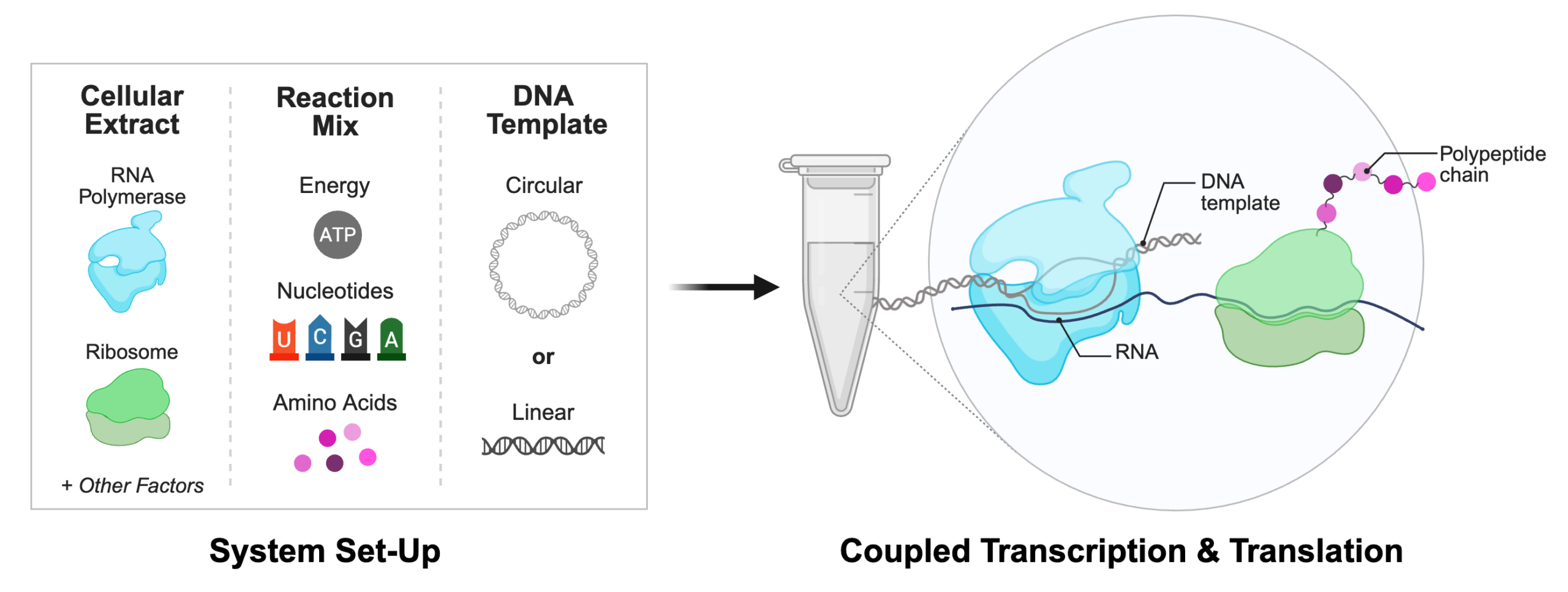
Cell-free systems offer several key advantages over traditional cell-based methods:
With cell-free protein expression, you can tackle even the most challenging research projects with speed and precision, achieving high purity and high yield by eliminating contaminating cellular byproducts and cell toxicity.
Cell-free protein expression provides a rapid way to produce and evaluate engineered Cas proteins directly from DNA templates. Instead of committing to lengthy cell-based expression or external protein production, researchers can screen multiple Cas variants, fusion proteins, and other CRISPR-associated proteins at the bench.
For CRISPR discovery workflows, CFPE can support:
This workflow makes it possible to move from DNA template to functional Cas protein in hours, accelerating CRISPR protein discovery and optimization.
Follow these steps to get started with cell-free protein expression:
Set Up the Reaction: Combine the cell extract, DNA template, reaction buffer, and any additional components (e.g., labeled amino acids) in the reaction chamber.
Incubate at a Constant Temperature: Place the reaction at the recommended temperature (typically 30°C) for 4–24 hours, depending on the kit and desired yield.
Detect the Desired Protein: Analyze the results using SDS-PAGE, Western blot, or other methods to confirm protein expression and purity.
Rapid screening and optimization are essential for testing multiple expression constructs, identifying the best conditions for protein production, and troubleshooting challenging targets. Variables such as template design, reaction conditions, and buffer composition are often screened to maximize yield and solubility.
Synthego's E. coli Cell-Free Protein Expression Kit
End Deliverable: Up to 20 µg of functionally active protein with high yield and purity, ready for further analysis or downstream applications.
Medium-scale protein production is ideal for applications requiring larger quantities of protein, such as structural biology (e.g., NMR spectroscopy, X-ray crystallography) or functional assays. This approach allows researchers to optimize reaction conditions for maximum yield and purity while scaling up from smaller screening experiments.
The Continuous Exchange Cell-Free (CECF) principle uses two semi-permeable membranes to exchange substrates and byproducts between a 1 ml reaction chamber and a 10 ml feeding chamber. This system continuously supplies essential components (e.g., energy, nucleotides, amino acids) while removing inhibitory byproducts, enabling protein expression to continue for up to 24 hours. Without this technology, reactions would stop prematurely due to depletion of substrates or accumulation of byproducts.
Synthego's E. coli High-Yield Cell-Free Protein Expression Kit
End Deliverable: Up to 6 mg of high-purity protein, suitable for structural studies or functional assays.
In traditional in vivo systems, incorporating labeled amino acids like selenomethionine or isotopically labeled amino acids (e.g., 15N or 13C) can be challenging. These systems often result in incomplete incorporation due to metabolic processes or contamination with naturally occurring amino acids. This can lead to variability in molecular weight and labeling efficiency, complicating downstream applications like crystallization or NMR studies.
The E. coli High-Yield Cell-Free Protein Expression Kit is uniquely designed to facilitate labeled amino acid incorporation. By separating amino acids from other reaction components, the system allows researchers to easily swap in labeled amino acids without disrupting the reaction. This flexibility ensures that your proteins are labeled exactly as needed for your experiments.
With our cell-free system, amino acids are supplied separately from other reaction components, allowing:
Note: Labeled amino acids are not included in the kit but are readily available from several suppliers in crystalline form.
Producing functional proteins often requires more than just the basic components of a cell-free system. Depending on the nature of your target protein, adding supplements like detergents, stabilizers, or chaperones can significantly improve yield, solubility, and functionality. Without these supplements, proteins may aggregate, lose activity, or fail to achieve their native conformation. Adding supplements can:
The E. coli High-Yield Cell-Free Protein Expression Kit is designed to allow the addition of supplements without disrupting the reaction. You can add:
To determine the best supplement conditions for your protein, we recommend starting with small-scale reactions using the E. coli Cell-Free Protein Expression Kit. Once optimal conditions are identified, they can be scaled up to the High-Yield Kit for larger reactions.
While cell-free protein expression offers many advantages, it can have some limitations:

 Cart
Cart
 Account
 Your Orders
 Sign Out
 Sign In