
In vitro transcription (IVT) serves as the engine for RNA therapeutic production, where final product quality is inextricably linked to the synergy between enzyme performance, reaction design, and analytical oversight.
The development of RNA-based therapeutics and vaccines—including messenger RNA (mRNA), self-amplifying RNA (saRNA), and circular RNA (circRNA)—requires tightly controlled manufacturing processes and comprehensive analytical characterization. Regulatory frameworks, including draft guidance from the United States Pharmacopeia (USP), emphasize defining and monitoring critical quality attributes (CQAs) to ensure identity, purity, potency, and safety.
As the foundational process for RNA therapeutics, In Vitro Transcription (IVT) functions within an integrated system where enzyme performance, reaction design, and analytical control ultimately define product quality. Synthego's IVT enzyme portfolio supports a holistic RNA synthesis workflow. This process ensures the consistent generation of high-quality linear and circular RNA, providing a reliable foundation for therapeutic discovery and process development.
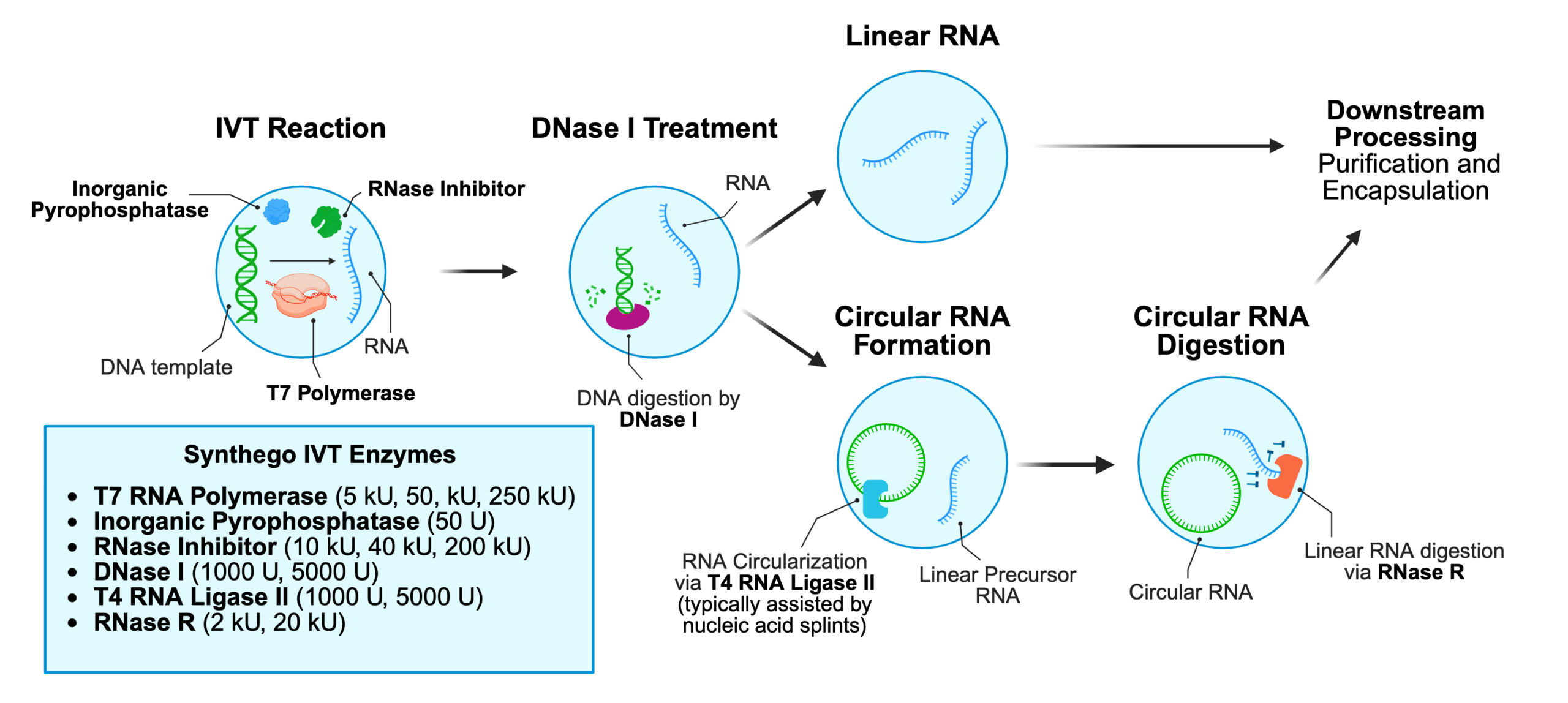

A high-efficiency enzyme for in vitro RNA synthesis, ideal for generating high yields of RNA for mRNA therapeutics, RNA probes, and other applications.
Specialized in dsRNA nick sealing and duplex-guided ligation (e.g., splint-assisted RNA circularization), supporting circular RNA and RNA library preparation workflows.
Protects RNA from degradation by ribonucleases, ensuring the stability and integrity of RNA during handling and processing.
An exonuclease that selectively degrades linear RNA while preserving circular RNA, making it an essential tool for circular RNA research and RNA quality control.
Enhances RNA synthesis reactions by removing inhibitory pyrophosphate, improving the efficiency and yield of in vitro transcription workflows.
An endonuclease that removes contaminating DNA from RNA preparations, ensuring the purity of RNA for sensitive applications like IVT and RT-PCR workflows and RNA sequencing.
All of our IVT enzymes can be lyophilized in custom volumes and packaging for use in your unique workflow.
RNA manufacturing begins with a well-characterized DNA template. IVT templates have traditionally been plasmid-derived (pDNA), though synthetic DNA is an emerging alternative that can offer advantages in purity, consistency, and design flexibility.
Central to template design is the selection and sequence optimization of the promoter region. The consensus sequence for the T7 RNA polymerase promoter is 5' TAATACGACTCACTATAG 3'. Transcription typically initiates at the final G (+1 position), which becomes the first base of your RNA transcript. While vectors may occasionally feature flanking promoters (such as SP6 or T3) for specific cloning or sense/antisense applications, T7 remains the industry standard due to its unmatched promoter specificity and high processivity.
When designing your DNA template, key sequence elements around the initiation site must align with your downstream process:
Prior to transcription, the template must meet defined specifications for:
Following linearization (for pDNA templates only) and purification, the DNA template serves as the substrate for IVT. Post-transcription, enzymatic digestion is required to remove residual template DNA and reduce downstream impurities in the RNA drug substance.
IVT is a cell-free enzymatic process that synthesizes RNA transcripts from DNA templates using bacteriophage RNA polymerases, most commonly T7 RNA Polymerase. This synthesis is supported by Inorganic Pyrophosphatase, which improves efficiency by reducing pyrophosphate accumulation, and RNase Inhibitor to protect the resulting transcripts from degradation throughout the reaction.
A typical mRNA construct consists of a 5′ cap, 5′ untranslated region (UTR), coding sequence, 3′ UTR, and poly(A) tail, all of which contribute to transcript stability, translation efficiency, and overall performance.
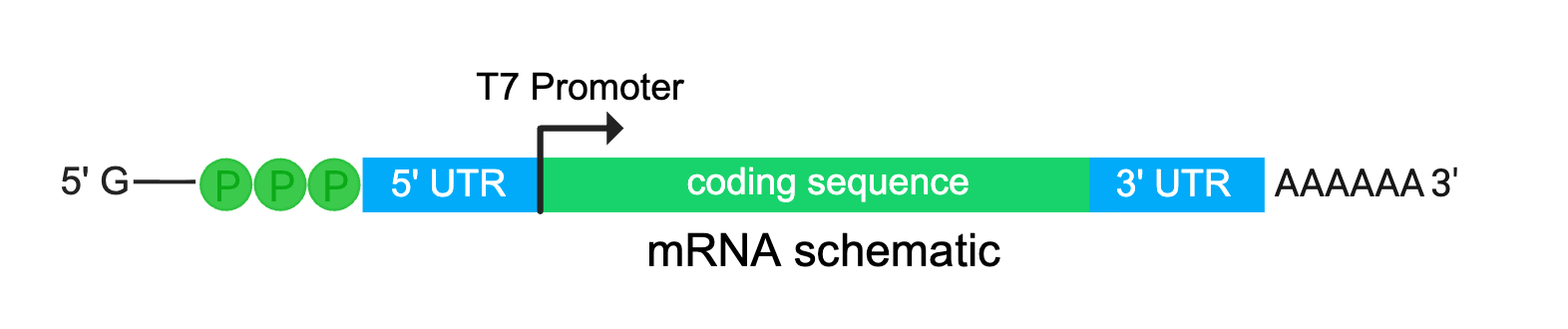
For messenger RNA (mRNA) and self-amplifying RNA (saRNA) constructs, co- and post-transcriptional modifications are critical to functional performance. 5’ capping strategies—implemented either through co-transcriptional cap analogs or enzymatic capping following transcription—are used to enhance ribosomal recruitment, improve translational efficiency, and reduce innate immune recognition. Similarly, the 3’ poly(A) tail is incorporated either directly via template-encoded sequences or added enzymatically post-transcription to support RNA stability and prolong intracellular half-life. Together, these modifications are essential determinants of potency and translational output.
Following transcription, residual DNA template should be removed using DNase I treatment to prevent DNA carryover, after which the RNA product is purified to remove enzymes, nucleotides, and incomplete transcripts prior to downstream processing and formulation.
Reaction parameters—including NTP balance, magnesium concentration, and incubation conditions—must be carefully controlled to maximize yield while minimizing impurities such as double-stranded RNA (dsRNA). While IVT output is a starting point, it does not define overall RNA quality. To reach the standard of a controlled drug substance, the raw transcription must undergo rigorous downstream processing and analytical validation.

RNA purification commonly combines several methods to efficiently separate full-length RNA from truncated species and impurity-associated dsRNA. dsRNA reduction is a key performance objective due to its impact on immunogenicity and downstream translational efficiency. As a result, purification functions as both a yield and safety control step.
Common purification strategies include:
In practice, these methods are rarely used in isolation. Common workflows combine enzymatic digestion (e.g., DNase I) with chromatography (IEX or RP-HPLC) and a polishing step such as UF/DF to balance impurity clearance with RNA recovery and scalability.
Purification performance is ultimately evaluated through its impact on critical quality attributes (CQAs), where reductions in residual DNA, dsRNA, and overall impurity burden are quantitatively verified. This direct linkage between process design and analytical readouts positions purification as a central component of the broader analytical framework for mRNA drug substance.
Regulatory guidance, including that from the United States Pharmacopeia, defines a broad set of critical quality attributes (CQAs) required to ensure mRNA drug substance quality and safety. In practice, a subset of these attributes—particularly those related to structural integrity, functional elements, and process-related impurities—serve as the most sensitive indicators of manufacturing performance.
Rather than being evaluated in isolation, CQAs are typically assessed across five interconnected categories:
| Category | Primary Objective | Common Analytical Methods |
|---|---|---|
| Identity & Sequence | Verifies the RNA transcript matches the intended genetic design. |
High-throughput sequencing (NGS) Sanger sequencing RT-PCR |
| Structural Integrity | Ensures full-length RNA and monitors for degradation or truncation. |
Capillary gel electrophoresis (CGE) Agarose gel electrophoresis |
| Functional Elements | Assesses features required for translation efficiency and stability. |
5′ Cap Efficiency: LC-MS/MS, IP-RP-HPLC Poly(A) Tail Length: LC-MS/MS, IP-RP-HPLC |
| Impurities | Monitors process-related and product-related contaminants. |
dsRNA: ELISA, dot blot Residual DNA: qPCR Residual NTPs: AEX-HPLC Residual Proteins: ELISA Purity: IP-RP-HPLC |
| Potency & Safety | Confirms biological activity and suitability for use. |
Potency: Cell-based protein expression assays Safety: Microbial and endotoxin testing |
These analytical outputs directly reflect upstream process performance. Attributes such as dsRNA content, capping efficiency, and residual DNA are particularly sensitive to IVT conditions, enzyme quality, and purification strategy.
As a result, analytical characterization functions not only as a release checkpoint, but as a feedback mechanism linking enzymatic performance and process design to final RNA quality.
While mRNA represents the most established RNA modality, circular RNA (circRNA) introduces additional process and analytical considerations. circRNA is characterized by a covalently closed structure, enabling enhanced stability and prolonged protein expression compared to linear mRNA.
Multiple approaches to circRNA manufacturing are currently being explored, including enzymatic ligation, ribozyme-mediated approaches, and permuted intron–exon (PIE) systems. The workflow described here highlights an enzymatic strategy based on IVT, ligation, and RNase-mediated enrichment, which aligns with widely adopted laboratory methods and is directly supported by Synthego’s IVT enzyme platform.
This approach involves a multi-step workflow integrating IVT, ligation, and enrichment:
Key process considerations include circularization efficiency, removal of linear RNA species, and control of ligation byproducts, all of which directly influence downstream analytical readouts and final product quality.
Compared to linear mRNA, circRNA analytical strategies are centered on confirming circularity and quantifying the removal of linear RNA species, which are key determinants of product purity and performance. Unlike mRNA, standardized regulatory frameworks for circRNA are still emerging, with current approaches largely informed by established guidance for RNA therapeutics from regulatory agencies such as the U.S. Food and Drug Administration and European Medicines Agency, and supplemented by a growing body of academic literature on circular RNA characterization (e.g., Wesselhoeft et al. 2018 Nature Communications; Chen 2020 Nature Reviews Molecular Cell Biology, Jiang et al. 2025 Nucleic Acids Research).
| Quality Attribute | Why It Matters | Analytical Approach |
|---|---|---|
| Circularity | Confirms covalently closed structure and resistance to exonuclease degradation | Exonuclease resistance assays (e.g., RNase R digestion profiling) |
| Purity (Linear RNA Removal) | Quantifies residual linear RNA following RNase R enrichment | HPLC, gel-based quantification |
| Size and Integrity | Verifies expected transcript length and detects degradation or incomplete ligation | CGE, denaturing PAGE |
| Sequence Identity | Confirms correct sequence, including back-splice junction integrity | NGS across back-splice junctions |
| Structural Confirmation | Validates circular topology and structural features beyond sequence | LC-MS, junction-specific assays |
| Potency | Measures functional protein expression from circular RNA | Cell-based protein expression assays |
In contrast to IVT-derived RNA modalities, sgRNA is typically produced via chemical synthesis. Single guide RNA (sgRNA), typically 100–120 nucleotides in length, requires analytical methods tailored to short RNA species. Read more about sgRNA synthesis and manufacturing methods in our guide: The Complete Guide to Understanding CRISPR sgRNA.
These controls are essential for sgRNA used in genome editing applications, where sequence fidelity and purity directly impact performance.
IVT is the central engine of RNA manufacturing, but final RNA quality is determined by the integration of enzyme performance, reaction design, purification strategy, and analytical control. Across mRNA, saRNA, circRNA, and short RNA workflows, these elements function as a connected system that defines identity, purity, and functional performance.
As RNA therapeutics advance, robust and reproducible IVT processes—paired with effective downstream processing and analytics—are essential for achieving consistent, scalable manufacturing outcomes. In this context, IVT is not just a synthesis step, but the foundation of RNA quality and process reliability.
Synthego’s IVT enzyme platform supports this integrated workflow, enabling consistent transcription performance and alignment across upstream and downstream steps to help accelerate development of high-quality RNA therapeutics.
 Cart
Cart
 Account
 Your Orders
 Sign Out
 Sign In