Learn more Webcast featuring eSpOT-ON
Explore More eSpOT-ON Nuclease Protein Available Now
Explore More Order eSpOT-ON Nuclease mRNA Now

How to Design DNA Templates for Cell-Free Protein Expression

A Comprehensive Guide to Mechanisms and Methods

Cell-free protein expression (CFPE) systems deliver the molecular machinery for transcription and translation in a single tube, enabling rapid protein expression directly from a DNA template without the constraints of cell culture. Also known as cell-free protein synthesis (CFPS), these platforms—particularly E. coli-based systems—offer high expression efficiency and cost-effectiveness, making them an ideal foundation for rapid prototyping and sequence optimization.

Designing and producing high-quality DNA templates is essential for a successful CFPE reaction, and this holds true for E. coli–based systems as well. This guide outlines the essential structural elements and format considerations for templates optimized for use with Synthego’s E. coli Cell-Free Protein Expression Kit and E. coli High-Yield Cell-Free Protein Expression Kit. The table below provides a summary of template compatibility and recommended applications for each kit:

Kit Name Linear DNA Supported? Circular DNA Supported? Recommended Use Case
E. coli Cell-Free Protein Expression Kit Yes Yes Rapid prototyping and parallel sequence optimization
E. coli High-Yield Cell-Free Protein Expression Kit Not recommended Yes (Preferred) Preparative-scale production and structural biology workflows

Essential Structural Elements of DNA Templates

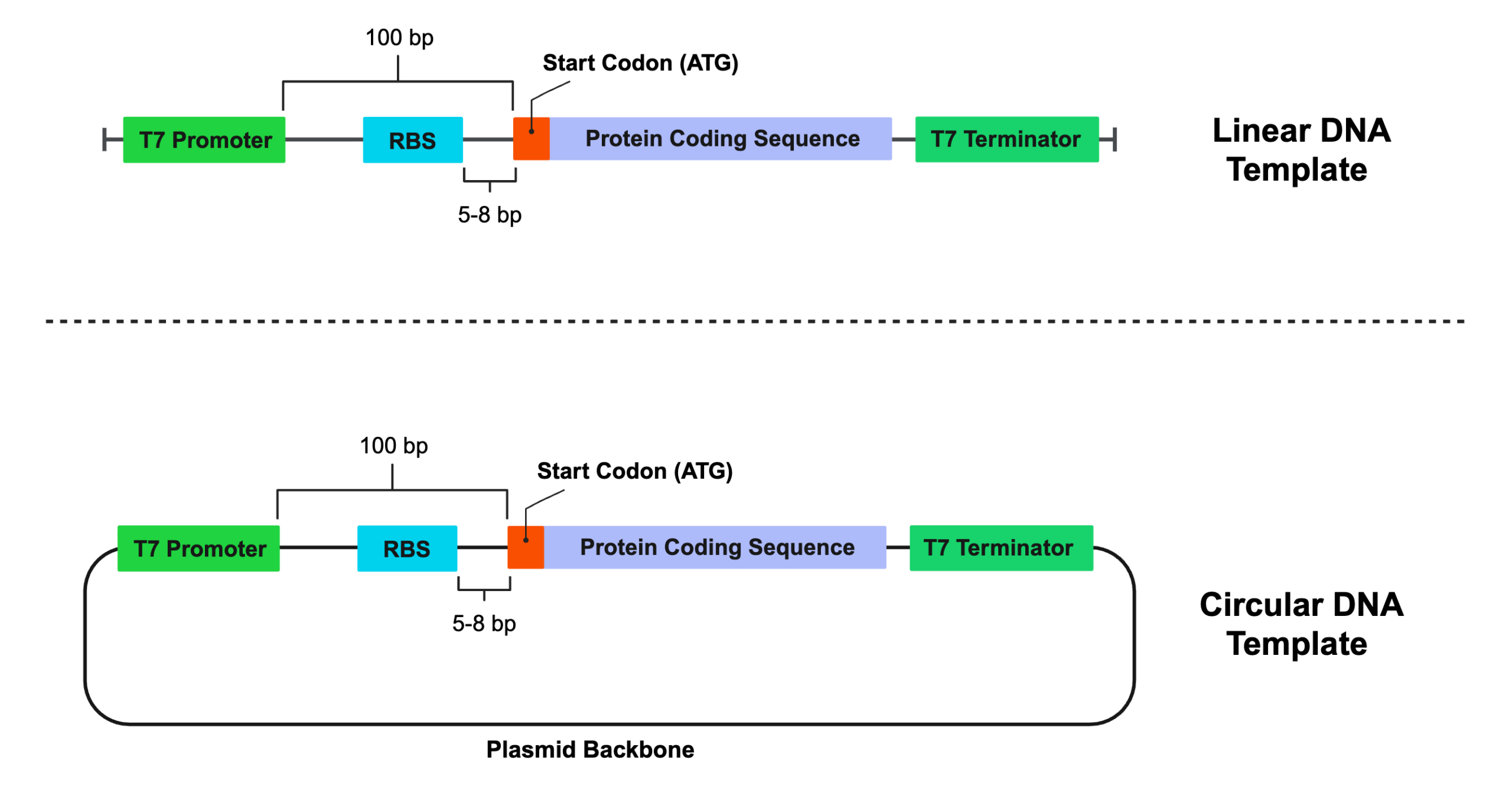
To be recognized by the CFPE machinery, DNA templates must contain the sequence encoding the target protein along with specific regulatory elements. In systems like Synthego’s CFPE offering, which are optimized for T7 regulatory elements, the following components are required:

  • Protein Coding Sequence (CDS): This provides instructions for the target protein, including any required tags or engineered mutations. The sequence must include a start codon (typically ATG, encoding methionine) to initiate translation; without it, the gene cannot be translated. For both linear and circular templates, the CDS can be obtained via PCR amplification from a plasmid, synthetic gene fragment, or cDNA library.
  • Ribosome Binding Site (RBS): Located upstream of the start codon, the RBS facilitates both ribosomal recruitment and binding to the mRNA transcript. For linear templates, kits like RTS Linear Template Kit Plus from biotechrabbit GmbH can introduce RBS sequences via specialized adaptor primers during PCR. For circular templates, specialized plasmids (such as biotechrabbit’s pIVEX) often include the RBS sequence.
  • T7 Promoter: This short DNA sequence upstream of the RBS is specifically recognized by T7 RNA polymerase and is required for mRNA transcription. It significantly enhances expression efficiency in E. coli-based CFPE systems. Like the RBS, it can be introduced via PCR adaptor primers for linear templates or encoded on an expression plasmid.
  • T7 Terminator Sequence: This signals the T7 RNA polymerase to halt transcription at the end of the coding sequence, ensuring the mRNA transcript encodes only the intended target protein. This is either encoded on the expression plasmid or added via PCR adaptor primers.
Image
Template architecture for high-efficiency protein synthesis using T7-driven expression systems, comparing both Linear DNA and Circular DNA (Plasmid) templates. For optimal expression, maintain approximately 100 bp between the T7 promoter and the start codon, and ensure the Ribosome Binding Sequence (RBS) is positioned 5-8 bp upstream of the start codon to facilitate efficient ribosomal binding.

Explore Synthego’s CFPE portfolio

Find the right solution for your workflow—from rapid prototyping to high-yield production.
Explore Our Cell-Free Kits
CTA Image

Template Formats: Linear vs. Circular DNA

Selecting the optimal template format depends on your specific goals, timeline, and yield requirements. When selecting a DNA template format for your CFPE experiment, we recommend considering the benefits and trade-offs below:

Speed and Turnaround Time

Linear DNA templates are often produced by PCR. Given the speed of most PCR reactions, new DNA templates can be generated within a few hours. This is beneficial for researchers who are screening multiple DNA templates in parallel or performing iterative DNA template optimization.

In contrast, producing a circular DNA template (plasmid) typically takes days. Creating custom plasmids requires cloning, and the speed of plasmid production is determined by microbial growth rates. Thus, using circular templates can significantly prolong the time required to perform CFPE reactions, particularly during screening or optimization of workflows.

Flexibility

Linear DNA templates also offer greater flexibility. PCR-based methods for generating linear DNA allow rapid and straightforward modification of a target gene sequence, including codon optimization or the introduction of specific mutations. These approaches also make it easy to add or swap tags, such as those used for labeling or purification.

In contrast, while circular DNA templates can accommodate a wide range of insert designs—including genes with various internal tags or modifications—creating new versions of a target gene in a plasmid typically requires a re-cloning step.

Power your CFPE Template Production with Synthego PCR Enzymes

Our comprehensive range of PCR & RT-PCR enzymes and products is designed to meet the diverse needs of modern molecular workflows, offering high performance and robust reliability for even the most challenging templates and conditions.
Explore Our PCR Tools
CTA Image

Protein Yield and Stability

Circular DNA templates for CFPE expression tend to result in better protein yields. Compared to linear DNA, plasmids tend to be more stable and persist longer in CFPE reactions, translating to greater protein expression. Due to this improved stability, circular DNA templates are required for longer-running and higher-yielding CFPE reactions. Synthego’s E. coli High-Yield Cell-Free Protein Expression Kit requires use of circular templates only.

Laboratory Resources

Producing either linear or circular DNA templates typically requires standard molecular biology tools. However, circular DNA templates also depend on basic microbiology techniques to maintain the bacterial strains that carry the plasmids.

One key advantage of circular DNA templates is their ease of long-term maintenance. Once a microbial strain harboring the plasmid is established, it can be cultured and propagated to provide a continuous, self-renewing source of template DNA. In contrast, linear DNA templates generated by PCR are consumable and generally need to be re-amplified or remade as they are used up.

In summary, linear DNA templates are faster to generate and offer greater experimental flexibility, while circular DNA templates are better suited for applications where sustained availability and high yield are priorities. As a result, workflows often begin with linear templates for rapid, small-scale optimization and later transition to circular templates for large-scale, high-yield protein production.

Accelerate Your Protein Engineering Workflow

Synthego provides two CFPE kits to power your cell-free workflows:

Getting Started

To master CFPE technology and drive confident experimental execution, consult our comprehensive technical documentation:

Customize Your Kit

Tailor your cell-free protein expression workflows with customizable kits designed to meet your unique research or production needs. From optimized reaction conditions to specialized supplements, our flexible solutions deliver precision and efficiency for any application.
Get In Touch
CTA Image

Partner With Us

Join us in making a profound difference in the world by enabling scientists to realize their full potential.

Lets Chat