Cart
 Account
 Your Orders
 Sign Out
 Sign In

How Do CRISPR Protein and mRNA Delivery Work?
At a high level, the difference between protein and mRNA delivery comes down to one simple question: Are you delivering the editor itself, or the instructions for making it?
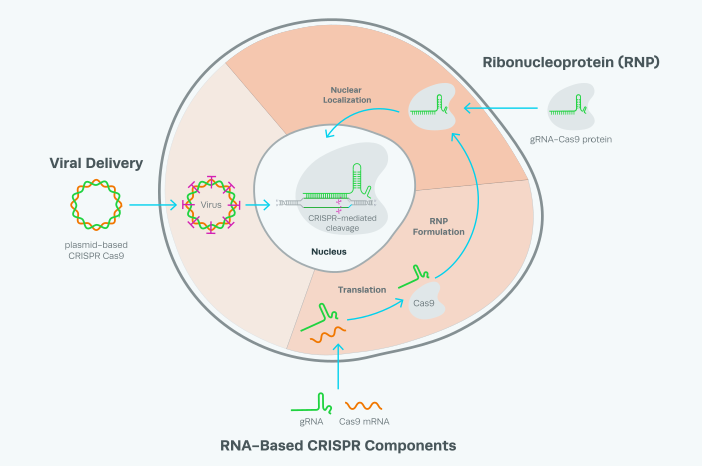
When you deliver the nuclease as protein, the protein is complexed with the guide RNA before it enters the cell. Instead of relying on the cell to build the editing machinery, you're delivering an editing complex that's already assembled and ready to begin its journey toward the target sequence.
Protein delivery pathway:
Protein + gRNA → RNP delivery → Target engagement → Editing → Protein degradation
With mRNA delivery, you're delivering the blueprints for making the nuclease. Once inside the cell, the mRNA must be translated into nuclease protein before editing can occur. The newly produced nuclease then associates with the guide RNA, locates its target, and initiates editing.
mRNA delivery pathway:
mRNA + gRNA delivery → Translation → Nuclease production → gRNA association → Target engagement → Editing
Although these workflows differ, neither creates a permanent source of nuclease activity. Delivered proteins are eventually degraded, while mRNA molecules are naturally broken down over time, along with the nuclease protein they produce. That distinction may seem straightforward, but it has practical implications. Delivering a pre-made editor versus delivering the instructions to build one can influence when editing begins, how long nuclease activity is available, and how you design the rest of your experiment. As we'll explore next, those differences can affect everything from sample collection timing to workflow optimization.
What Goes Into a CRISPR Delivery Strategy?
Successful CRISPR delivery involves more than choosing a delivery method. Explore how cargo formats, delivery vehicles, and biological challenges influence the approaches researchers use to deliver CRISPR components.
When Does CRISPR Editing Begin After Delivery?
Think about what happens immediately after your editing components enter the cell. With RNP delivery, the nuclease and guide RNA can already be assembled and ready to act once they reach the appropriate cellular compartment. This supports a relatively rapid onset of editing activity. Because the introduced protein is eventually degraded, its availability is also temporary. With mRNA, there is an additional step. Your cells need to translate the delivered mRNA before the nuclease becomes available. How much protein is produced, and when, depends on factors such as mRNA stability, translation efficiency, and the biological system you're working with. Does that mean protein always acts faster, and mRNA always remains active longer? Not necessarily. Both formats provide transient nuclease availability, and their actual activity profiles depend on your delivery conditions, cell type, and experimental system. The goal isn't necessarily to keep the nuclease active for as long as possible. It's to understand when editing is likely to occur and whether that timing supports your experiment. This also matters when you evaluate your results. An early time point may help you assess editing kinetics, while later measurements may be needed to evaluate the resulting genetic changes or downstream biological effects. Rather than assuming the same analysis timeline will work for both formats, consider how the path to active editing may affect when you collect your samples.
One of the biggest workflow differences between CRISPR delivery formats comes down to timing. Think of it this way: when you deliver an RNP, you're introducing a pre-built editing machine. The Cas protein and guide RNA are already assembled and ready to get to work once they reach the right place inside the cell. Editing can begin relatively quickly because the cell doesn't need to build anything first. mRNA takes a different route. Instead of delivering the editor itself, you're delivering the instructions for making it. Before editing can begin, the cell must translate that mRNA into Cas protein. How quickly that happens, and how much protein is ultimately produced, depends on factors like mRNA stability, translation efficiency, and the biology of the cells you're working with. It's tempting to think of this as a simple "RNP is faster, mRNA lasts longer" comparison. In reality, the picture is more nuanced. Both approaches are transient, and the timing of editing activity can vary based on cell type, delivery method, and experimental conditions. What matters most isn't necessarily how long the nuclease sticks around. It's understanding when editing is likely to occur so you can align your workflow accordingly. The optimal time to measure editing outcomes may differ depending on the format you choose. Early time points can help you capture editing activity as it happens, while later analyses may be needed to assess the resulting genetic changes or downstream biological effects. The takeaway? Your delivery format doesn't just influence how editing components enter the cell. It can also shape when you collect samples, analyze results, and make experimental decisions.
What Influences CRISPR Editing After Delivery?
Choosing between RNP and mRNA is an important decision, but it's only one piece of the editing puzzle. In practice, successful genome editing depends on how multiple variables work together.
Your cells matter. A workflow that delivers excellent results in an immortalized cell line may not perform the same way in primary cells or more difficult-to-transfect models. Cell health, uptake efficiency, and intracellular biology all influence editing outcomes. For mRNA-based approaches, there's an additional requirement: cells must efficiently translate the delivered transcript into functional nuclease before editing can begin.
Your delivery method matters. Even the best editing components can't work if they don't reach the cell. Electroporation and nucleofection are commonly used to introduce both RNPs and mRNA, while RNA-friendly approaches such as lipid nanoparticles (LNPs) have expanded options for nonviral delivery, particularly for in vivo applications. The delivery technology you choose can significantly influence both efficiency and experimental design.
Your guide RNA matters. Regardless of whether the nuclease enters as a protein or is produced from mRNA, editing still depends on the guide RNA finding the right target. Guide design, stability, and overall quality can affect editing performance. The guide may play slightly different roles in RNP and mRNA workflows, but in either case it's a critical component of the system.
Your dose matters too. Switching from protein to mRNA isn't simply a matter of matching quantities. With RNP delivery, you're introducing the editor directly. With mRNA delivery, you're introducing the blueprint the cell uses to manufacture that editor. As a result, dosing strategies that work well for one format don't always translate directly to the other.
The key takeaway is that CRISPR workflow optimization is rarely about a single variable. Changing your delivery format can influence everything from delivery conditions and dosing strategies to experimental timing and data collection. That's why the most effective workflow isn't always the one that uses a particular format. It's the one where all of the moving pieces work together to support your experimental goals.
Looking to Build Your CRISPR Workflow?
From selecting your target and designing guide RNA to delivering your editing components and evaluating results, explore the key steps involved in planning a CRISPR experiment.

How to Select a CRISPR Format for My Workflow?
After comparing protein and mRNA delivery, the obvious question becomes: Which format is right for your experiment?
Consider the biological system you're working with. Are you editing a robust cell line or a more challenging primary cell type? What delivery methods are available in your lab? Do you need editing activity to begin as quickly as possible, or does your workflow benefit from intracellular nuclease expression following mRNA delivery? The answers can help guide which format is the best fit. The good news is that there isn't a universally "best" option. Both protein and mRNA have enabled successful genome editing across a wide range of research applications. The key is understanding the tradeoffs and determining which approach aligns most closely with your experimental goals, delivery strategy, and timeline.
How Can Synthego Support My CRISPR Workflow?
Once you've identified the delivery strategy that makes the most sense for your experiment, the next step is ensuring that all of your editing components work together as a complete system. Guide RNA quality, delivery strategy, and reagent compatibility can all contribute to the efficiency and reproducibility of your results. That's why you should evaluate your workflow as an integrated solution rather than a collection of individual components.
Synthego offers SpCas9, eSpOT-ON, and hfCas12Max nucleases in both protein and mRNA formats, giving you flexibility to choose the delivery approach that best fits your experimental system. Combined with chemically modified synthetic guide RNAs, these options support a wide range of genome editing applications, from preassembled RNP workflows to mRNA-based approaches that leverage intracellular nuclease production.
Whether you're optimizing an existing protocol or evaluating a new editing strategy, access to both protein and mRNA formats can help you build a workflow that aligns with your research objectives, delivery method, and biological model.
Which CRISPR Editor Fits Your Research?
From gene knockouts to precise sequence modifications, different editing goals call for different CRISPR tools. Explore Synthego's portfolio of nucleases and base editors, including their capabilities, targeting considerations, and available formats, to help identify the right approach for your experiment.