
Key Principles for Successful RPA Assay Development
RPA primer design is critical to achieving sensitive, specific, and low-background amplification in Recombinase Polymerase Amplification (RPA) and Reverse Transcription RPA (RT-RPA) assays.
Because RPA operates under isothermal conditions (37–42°C), primer behavior differs significantly from PCR. Primers must be designed specifically for recombinase-mediated amplification to ensure optimal performance.
For reliable amplification performance, RPA primers should follow these guidelines:
Important: Primers should be designed specifically for RPA and not directly reused from PCR workflows.
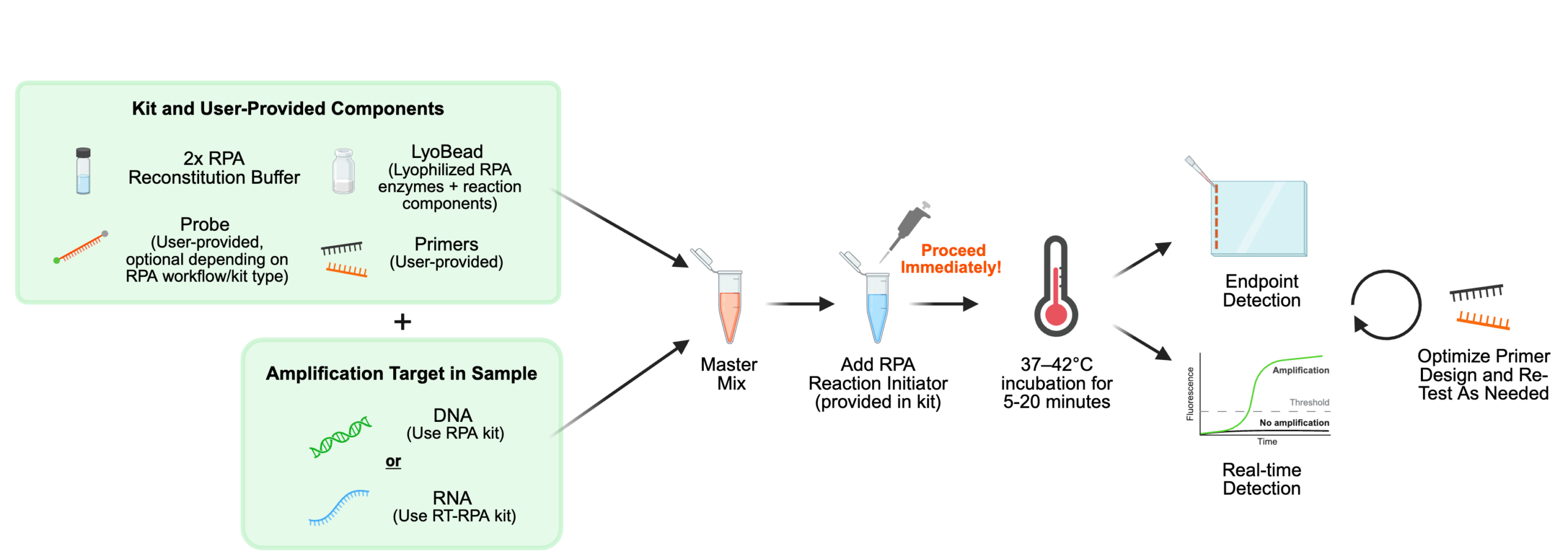
Detection strategy has a major impact on primer and probe design requirements. Synthego's Real-Time RPA and RT-RPA kits integrate the Exonuclease III (Exo) enzyme to cleave user-designed probes and facilitate real-time detection. Probe formats other than Exo probes require independent optimization and validation by the user. Certain endpoint detection methods, such as lateral flow, require custom labeling strategies via modified primers or probes, and similarly, such labeling strategies need independent optimization and validation.
For endpoint assays (e.g., lateral flow):

Successful RPA assay development relies on more than simply selecting primers that bind the target sequence. Primer length, sequence composition, secondary structure, primer-dimer potential, detection method, and empirical screening all play important roles in assay performance. Small design decisions can have a significant impact on amplification efficiency, specificity, and overall assay reliability.
The principles covered on this page provide a strong foundation for RPA primer design. However, moving from a functional assay to a robust, optimized assay often requires additional design, testing, and troubleshooting. For a deeper dive, download the complete RPA Assay Execution and Optimization Checklist, which includes advanced primer and amplicon design strategies, probe design guidance, step-by-step assay development workflows, optimization recommendations, and troubleshooting best practices.

 Cart
Cart
 Account
 Your Orders
 Sign Out
 Sign In