Learn more Webcast featuring eSpOT-ON
Explore More eSpOT-ON Nuclease Protein Available Now
Explore More Order eSpOT-ON Nuclease mRNA Now

Recombinase Polymerase Amplification (RPA) and Reverse Transcription RPA (RT-RPA)

A Comprehensive Guide to Mechanisms and Methods

Recombinase Polymerase Amplification (RPA) is a rapid, isothermal nucleic acid amplification technology that offers a powerful alternative to traditional methods like PCR. By operating at a single, low temperature, RPA and its variant, Reverse Transcription RPA (RT-RPA), enable sensitive and specific detection of DNA and RNA sequences. This makes them highly efficient tools for molecular diagnostics, field-based testing, and point-of-care applications where speed and simplicity are essential.

Ready to get started with Synthego's RPA Kits?

Achieve reliable and reproducible results. Synthego offers a portfolio of advanced RPA kits and reagents engineered for maximum efficiency and specificity. Our tools are designed to streamline your workflow and deliver the accuracy your research demands.
Explore Our RPA Kits
CTA Image

How Does RPA Work? The Mechanism Explained

The RPA mechanism mimics natural DNA repair processes, utilizing a unique combination of enzymes to achieve exponential amplification without the need for thermal cycling. This isothermal DNA amplification process is both elegant and robust.

The RPA mechanism proceeds in three core steps:

  1. Primer Recombination: Recombinase enzymes bind to single-stranded DNA primers, forming nucleoprotein complexes. These complexes actively scan double-stranded DNA to find the matching homologous sequence.
  2. Strand Invasion: Upon locating the homologous site, the primer-recombinase complex invades the DNA duplex. This action separates the DNA strands and creates a D-loop structure, providing a binding site for DNA polymerase.
  3. DNA Synthesis: A strand-displacing DNA polymerase binds to the primer and begins synthesis. As it extends the primer, it displaces the original template strand. This cycle repeats, resulting in the exponential amplification of the target DNA sequence.

This isothermal process is the key distinction when comparing RPA to PCR. The absence of high-temperature denaturation steps and thermal cycling simplifies the required instrumentation and significantly reduces amplification time.

Explore our RPA Endpoint Kit and RPA Real-Time Kit to learn more.

Choosing Between Isothermal Methods?

Not sure whether RPA or LAMP is the better fit for your assay? Both methods enable rapid molecular detection—but their workflows, primer design, and device requirements differ significantly. Learn how they compare in our detailed guide.
Read Our Comparison
CTA Image

How Does RT-RPA Work? The Mechanism Explained

The RT-RPA mechanism integrates the synthesis of complementary DNA (cDNA) from an RNA template with subsequent isothermal amplification. This single-tube process enhances workflow efficiency and minimizes contamination risk.

The RT-RPA mechanism proceeds in three core steps:

  1. Reverse Transcription: A reverse transcriptase enzyme synthesizes a single strand of cDNA from the target RNA molecule using a specific primer. This initial step converts the RNA target into a stable DNA template for amplification.
  2. Primer Recombination: Recombinase enzymes coat the RPA primers, forming nucleoprotein filaments that scan the newly synthesized cDNA for homologous sequences.
  3. Strand Invasion and Amplification: The primer-recombinase complex invades the target DNA sequence and a strand-displacing DNA polymerase then initiates the synthesis and elongates the primer. Repeated cycles of this reaction lead to exponential amplification of the cDNA template. The entire reaction occurs at a single, low temperature, a key differentiator in the RT-RPA vs RT-PCR comparison.

Explore our RT-RPA Endpoint Kit and RT-RPA Real-Time Kit to learn more.

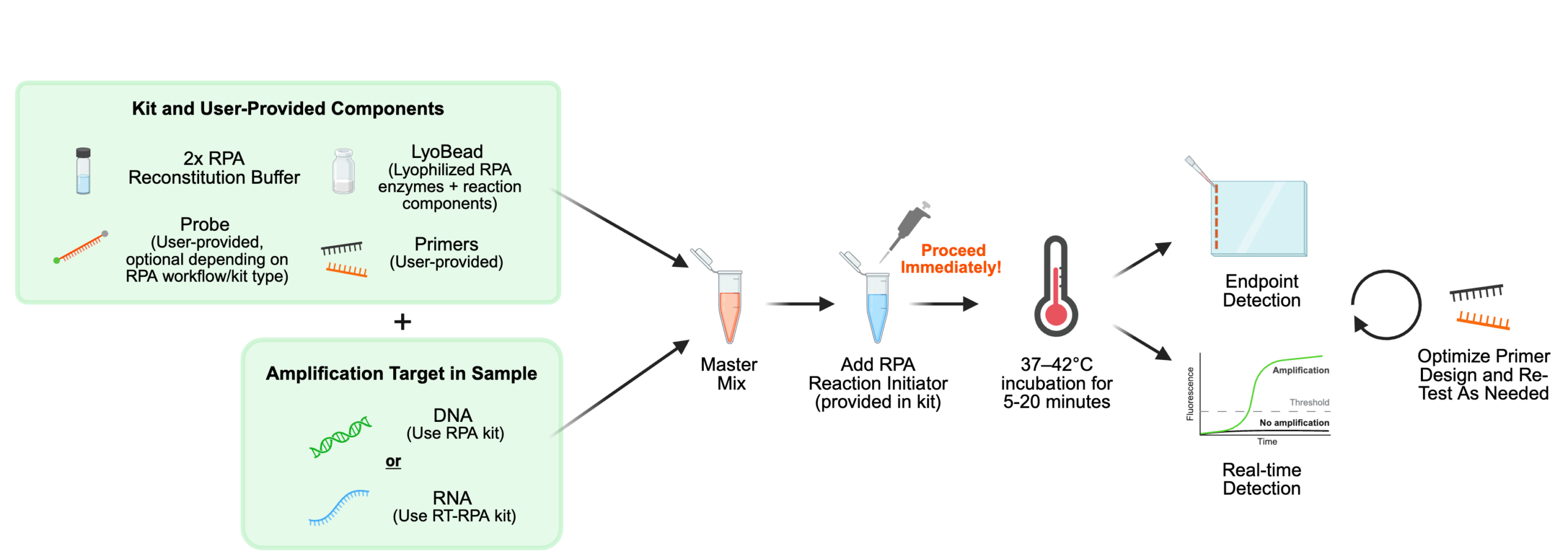
Unified Protocol: How to Perform RPA and RT-RPA

The beauty of these technologies lies in their operational simplicity. Whether you are targeting DNA (RPA) or RNA (RT-RPA), the workflow remains a rapid, single-tube process requiring minimal equipment.

Step-by-Step RPA & RT-RPA Protocol

  1. Prepare the Master Mix: Rehydrate the lyophilized pellet with the provided rehydration buffer.
    • For RPA: The pellet contains all necessary enzymes (Key components including recombinase and DNA polymerase).
    • For RT-RPA: The pellet contains all necessary enzymes (Key components including reverse transcriptase, recombinase, DNA polymerase).
  2. Add Primers & Probes: Incorporate your optimized primer/probe set directly into the mix.
  3. Introduce the Sample: Add your purified nucleic acid (DNA or RNA) to the reaction tube.
  4. Isothermal Incubation: Incubate at a constant temperature (typically 37°C–42°C) using a simple heat block or water bath.
    • RPA Time: 5–20 minutes.
    • RT-RPA Time: 15–20 minutes (to allow for the integrated reverse transcription step).
  5. Detection: Analyze results in real-time via fluorescence or at the endpoint using lateral flow strips.


Essential Best Practices

To ensure reliable and reproducible results across either assay, keep these three pillars in mind:

  • Primer Optimization: Isothermal amplification is highly sensitive to primer design; always screen multiple sets to find the highest specificity.
  • Contamination Control: Maintain a strict "clean-room" workflow to prevent aerosolized amplicon carryover.
  • RNA Integrity: For RT-RPA, use RNase-free reagents and tips to prevent the degradation of your target template before the reaction begins.

RPA vs. RT-RPA: A Direct Comparison

Feature Recombinase Polymerase Amplification (RPA) Reverse Transcription RPA (RT-RPA)
Primary Target DNA RNA
Key Enzymes Recombinase, DNA Polymerase Reverse Transcriptase, Recombinase, DNA Polymerase
Workflow Single-step amplification of DNA. Single-tube reverse transcription and amplification of RNA.
Applications DNA-based diagnostics, food safety testing, environmental monitoring. RNA virus detection, gene expression analysis, point-of-care RNA diagnostics.
Key Advantage Extremely rapid and simple DNA amplification. Fast and simplified RNA detection without a separate cDNA synthesis step.

Frequently Asked Questions

What is RPA used for?
RPA is used for the rapid amplification of DNA for applications in clinical diagnostics, point-of-care testing, food safety, and environmental monitoring.

Check out our RPA Endpoint Kit and RPA Real-Time Kit to learn more.
What is RT-RPA used for?
RT-RPA is primarily used for the rapid amplification and detection of RNA targets. Its main applications are in the diagnosis of RNA viruses, point-of-care testing, and fast-track gene expression analysis.

Check out our RT-RPA Endpoint Kit and RT-RPA Real-Time Kit to learn more.

Can RPA be used for RNA Amplification?
Yes. To amplify RNA, a reverse transcription step must first be performed to convert RNA into cDNA, which can then be amplified using a standard RPA protocol. This is known as RT-RPA. Check out our RT-RPA Endpoint Kit and RT-RPA Real-Time Kit to learn more.

What is the function of the reverse transcriptase in RT-RPA?
The reverse transcriptase enzyme converts the target RNA into a stable complementary DNA (cDNA) template within the same reaction tube, which is then amplified by the RPA process.

How is RPA / RT-RPA different than PCR?
The primary difference in RPA vs PCR is that RPA is an isothermal DNA amplification method, operating at one low, constant temperature, while PCR requires repeated cycles of heating and cooling. This makes RPA significantly faster, more portable and simpler to perform.

What equipment is needed for RPA / RT-RPA?
Basic RPA / RT-RP equipment includes a simple heating block or water bath capable of maintaining a constant temperature and a detection device, such as a fluorometer or lateral flow reader.

Customize Your Kit

Tailor your isothermal amplification workflows with customizable RPA kits designed to meet your specific diagnostic or research needs. From optimized reaction conditions to lyophilization, our flexible solutions ensure precision and reliability for any application.
Get In Touch
CTA Image

Partner With Us

Join us in making a profound difference in the world by enabling scientists to realize their full potential.

Lets Chat