Cart
Cart
 Account
 Your Orders
 Sign Out
 Sign In

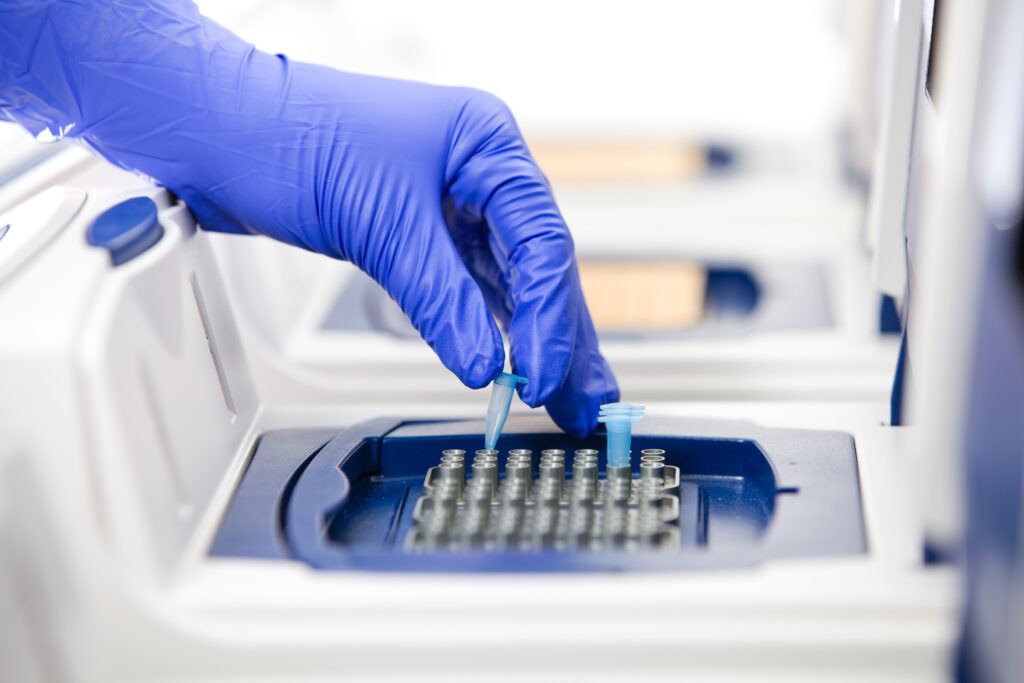
Among the many variables that shape polymerase chain reaction (PCR) performance, enzyme selection stands out as a defining factor in downstream success. While it may be tempting to view DNA polymerase as a generic commodity, modern molecular biology is far more nuanced. The enzyme you choose directly influences yield, processivity, specificity, and fidelity—ultimately determining the quality and reliability of your results.
If you’re pushing the boundaries of genomic analysis, “good enough” rarely is. Whether you’re performing routine genotyping, complex cloning, or preparing libraries for next-generation sequencing (NGS), polymerase selection can mean the difference between clean, reproducible amplification and frustrating non-specific byproducts.
At Synthego, we offer three purpose-built polymerase formulations—Taq DNA Polymerase, Hot-Start Taq DNA Polymerase, and High-Fidelity Hot-Start DNA Polymerase—each engineered to address distinct experimental demands. This guide will help you identify the optimal enzyme for your specific application.
Your PCR Success Starts Here
From DNA polymerases, reverse transcriptases, and nucleotide solutions, we have the tools you need for consistent, high-quality results—even with challenging templates.

The Workhorse: Taq DNA Polymerase
The Basics
If you need a dependable, everyday PCR enzyme, standard Taq Polymerase is your go-to option. This robust, thermostable enzyme is built for reliability and consistency.
When It's Right For You
Because it lacks proofreading capability, this enzyme isn’t ideal when sequence precision is critical (such as cloning for protein expression). However, if you’re running high-throughput screening where you need a clear “presence/absence” answer, it’s hard to beat.
- Routine PCR: Amplifying targets up to 3 kb
- Genotyping: Reliable detection of genetic variants
- Colony PCR: Screening transformants quickly
- TA Cloning: Taking advantage of 3′-A overhangs for direct ligation into T-vectors
The Bottom Line: Choose standard Taq DNA Polymerase when you need a cost-effective, reliable solution for routine screening or diagnostic workflows where ultra-high fidelity isn’t the limiting factor.
The Specialist: Hot-Start Taq Polymerase
The Basics
If you’ve ever dealt with primer-dimers or non-specific amplification before cycling even begins, you know how frustrating background noise can be.
Our Hot-Start Taq DNA Polymerase solves this problem using antibody-mediated inhibition. The enzyme remains inactive at room temperature, preventing unwanted primer extension while you’re setting up reactions. It only activates once your reaction reaches 95°C during initial denaturation.
For researchers developing custom hot-start systems, we also offer a Taq DNA Polymerase Antibody as a standalone component.
When It’s Right for You
If specificity and sensitivity are critical, this formulation gives you an edge.
You’ll benefit most if you’re working with:
- Low-Copy Number Targets: When your template is scarce and every molecule matters
- Complex Templates: GC-rich regions (up to 70%) or inhibitor-containing samples like blood (up to 20%), humic acid, or ethanol
- Multiplex PCR: Multiple primer sets increase primer-dimer risk—hot-start technology helps control it
The Bottom Line: Select Hot-Start Taq when your assay demands high specificity, improved sensitivity, and the flexibility of room-temperature setup.
The Perfectionist: Hot-Start DNA Polymerase, High Fidelity
The Basics
When sequence accuracy is non-negotiable, standard Taq isn’t enough.
Hot-Start DNA Polymerase, High Fidelity is engineered for precision. This recombinant enzyme includes 3′→5′ exonuclease (proofreading) activity, allowing it to correct nucleotide misincorporations during synthesis.
The result? Approximately 50× higher fidelity than standard Taq polymerase—delivering the exceptionally low error rates you need for high-stakes downstream applications. Like Hot-Start Taq, it uses antibody-mediated activation for specificity, but it produces blunt-end products instead of A-overhangs.
When It’s Right for You
If even a single base-pair error could compromise your experiment, this is your enzyme.
Ideal applications include:
- Cloning & Expression: Preserve coding sequences without introducing mutations
- NGS Library Amplification: Ensure your sequencing data reflects the original template—not amplification artifacts
- Long-Range PCR: Robust amplification up to 10 kb targets
- Blunt-End Cloning: Direct ligation into blunt-end vectors
The Bottom Line: If your downstream workflow involves sequencing, protein expression, or NGS, high-fidelity polymerase is the safest choice for minimizing amplification-induced errors.
Master the Mechanics of PCR
Deepen your understanding of how PCR works and explore key insights that make amplification more predictable. Read our latest guide to get a clearer view of the process behind every successful experiment.
Summary Comparison
|
Feature
|
Taq DNA Polymerase
|
Hot-Start Taq DNA Polymerase
|
Hot-Start High Fidelity DNA Polymerase
|
|
Fidelity
|
Standard
|
Standard
|
High (~50× Standard Taq)
|
|
Proofreading
|
No
|
No
|
Yes (3'→5' exo)
|
|
Hot-Start
|
No
|
Yes (Antibody)
|
Yes (Antibody)
|
|
Product Ends
|
3'-A Overhangs
|
3'-A Overhangs
|
Blunt
|
|
Optimal Target Size
|
≤ 3 kb
|
≤ 5 kb
|
≤ 10 kb
|
|
Best For
|
Routine Screening, RT-PCR, TA Cloning
|
Complex Templates, Multiplexing, Routine Screening, RT-PCR, TA Cloning
|
Sequencing, Cloning, Long-range PCR
|
Customization and Quality
Your workflow may not fit neatly into a standard catalog offering—and that’s okay.
At Synthego, all three polymerase formulations are available with flexible customization options to match your throughput, storage, and regulatory needs:
- Concentration & Volume: Packaging sizes aligned with your scale
- Formulation: Liquid or lyophilized formats
- Custom Master Mixes: Built around your optimized protocol to simplify workflow and reduce variability
When you align your polymerase choice with your specific application—whether your priority is cost-efficiency, specificity, or absolute precision—you set yourself up for reproducible, high-quality data.
Conclusion
Selecting the right DNA polymerase isn’t just a detail—it’s the foundation of reliable, reproducible results. Whether your priority is speed, specificity, or pinpoint accuracy, understanding the strengths of Taq, Hot-Start Taq, and High-Fidelity polymerases empowers you to choose the enzyme that aligns with your experimental goals. Take the first step toward cleaner amplification and confident data by matching your workflow with the polymerase designed for it.
Customize Your PCR Reagents