Cart
Cart
 Account
 Your Orders
 Sign Out
 Sign In


Imagine a patient walking into a community clinic for routine STI screening—the person relying on the test you’re designing. They provide a sample, hear that the clinic will contact them with their results, and walk back out the door feeling perfectly healthy. From that moment, two clocks start ticking.
The first follows the sample. It is packaged, transported to a laboratory, accessioned, queued for testing, processed, and analyzed before a result makes its way back to the clinic. Even in a highly automated system, every step adds time between sample collection and an actionable answer.
The second clock follows the patient, and it does not wait for the laboratory result.
Because many sexually transmitted infections are asymptomatic, patients rarely know to adjust their sexual health practices while awaiting test results. This makes rapid turnarounds essential to preventing unintentional transmission. They go back to work, school, relationships, and everyday life. During that interval, opportunities for transmission remain. And as the days pass, another challenge emerges: getting the patient back into care. Calls can go unanswered, follow-up can be delayed, and the impact of your assay diminishes with every passing hour.
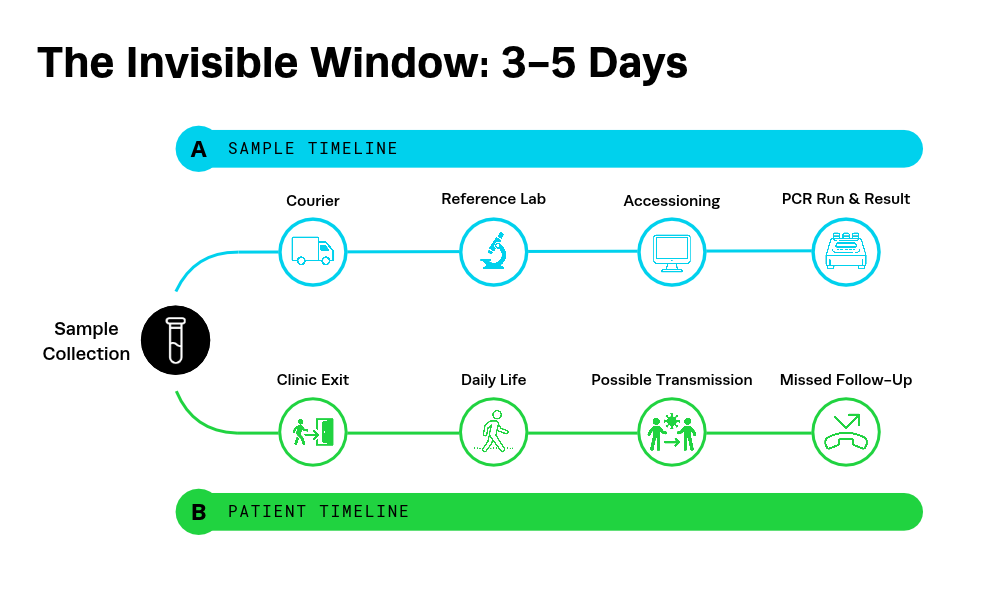
That gap between testing and treatment is the invisible window: the period when the healthcare system is working toward an answer, but the patient—and potentially the infection—keeps moving. For STI diagnostics, closing that window is becoming one of the industry's most important challenges. The question is no longer simply, Can we detect the infection? Increasingly, it is: Can we detect it fast enough to change what happens next?
How is the STI Diagnostics Market Changing?
That invisible window isn't just a challenge for clinicians. It's helping shape what the next generation of STI diagnostics needs to accomplish. The global STI diagnostics market is valued at roughly $11.91 billion in 2026 and is projected to reach as much as $23.95 billion by the early 2030s. But those numbers only tell part of the story. The more interesting question is what that growth is asking diagnostic developers to build.
It’s tempting to look at a market this large and focus on the instruments: automated liquid handlers, high-throughput PCR systems, and the increasingly sophisticated platforms filling modern diagnostic laboratories. But an instrument can only perform as well as the assay running inside it. Behind every result is a carefully engineered combination of enzymes, primers, probes, buffers, and other reagents responsible for turning a patient sample into a signal you can trust. And as STI testing evolves, those assay requirements are changing.
In one setting, the challenge might be: How can a lab reliably process thousands of samples today? In another, it might be: Can a clinician give this patient an answer before they leave the clinic. For assay developers, these two STI diagnostic challenges demand entirely separate development paths. But solving each requires very different approaches to speed, scale, workflow, and assay chemistry. That is why the future of STI testing is increasingly taking shape across two very different environments.
Model 1: Centralized High-Throughput Surveillance Hubs
Start with the environment that already handles a significant share of STI testing today: the centralized laboratory. There are good reasons this model works. STI testing isn't always a simple matter of looking for one pathogen in one sample. Clinicians may need to distinguish between infections with similar presentations, test for multiple pathogens at once, or perform additional testing that informs treatment and disease management.
Now multiply that complexity across hundreds or thousands of samples. That is where centralized laboratories excel. Automation and high-throughput molecular testing allow labs to process large sample volumes with the consistency and controls required for clinical diagnostics. PCR and RT-PCR have become particularly important tools because they can detect small amounts of target nucleic acid while supporting highly specific and multiplexed assays.
The Search for Signal in the Noise
At this scale, your biggest technical challenge isn't simply about making amplification faster. Your assay has to perform reliably, run after run, even as you add more targets and more complexity. That puts enormous pressure on your chemistry. Your polymerases, reverse transcriptases, primers, probes, and other assay components must work together without sacrificing sensitivity or specificity. Add more targets to the same reaction, and you also add more opportunities for competing reactions, nonspecific amplification, background signal, and differences in amplification efficiency.You can automate sample handling. You can increase plate capacity. You can optimize how quickly samples move through your laboratory. But if your underlying chemistry can't reliably pull a low-copy target out of a complicated biological background—or maintain performance as your multiplex grows—the rest of that efficiency only gets you so far.
In other words, you can automate the workflow, but you can't automate your way around weak chemistry.
So What's the Catch?
The centralized model is exceptionally good at what it was built to do: process large numbers of samples efficiently, support broad screening programs, and observe emerging threats, including antibiotic-resistant superbugs. But there's one variable you can't fully optimize in assay development: the distance between the patient and their result.
A sample still has to reach the lab and enter the facility's workflow. The result still has to travel back to the clinician and, ultimately, to the patient. As an assay developer, you can shave minutes off extraction protocols, optimize amplification times, and enable total lab automation for every step after sample arrival. But no matter how fast your assay runs on a central platform, it cannot eliminate the physical transport time. Meanwhile, the patient is still living on a completely different clock. And that's the central tension behind the invisible window. Making the laboratory faster doesn't necessarily make the answer immediate for the patient.
Instead of asking how to move the sample through the system faster, what if you change the equation entirely? What happens when you move the test directly to the patient?
Building your next PCR or RT-PCR diagnostic assay?
Model 2: Decentralized "Test-and-Treat" Action Sites
Now move the test to an urgent care desk, a retail pharmacy counter, or a local community clinic. Suddenly, the priorities look very different. You're not trying to force your assay into model 1 and optimize for high throughput testing. You're trying to answer a much more immediate question: Can you give the person standing in front of their doctor an actionable result before they leave? This is the promise behind the "Test-and-Treat" model.
The patient provides a sample and testing begins while they're still at the clinic. Instead of waiting days for a call or portal notification, they could receive a definitive result during the same visit, giving their clinician an opportunity to make an informed treatment decision while they're still there. Think back to the invisible window. You've just compressed it from days to potentially less than an hour. And that's a very different diagnostic accomplishment.
What Does "Test-and-Treat" Look Like in the Real World?
You don't have to imagine the model entirely from scratch. Express sexual health clinics have already explored what happens when you redesign the patient journey around faster testing. Pioneering programs like London’s Dean Street Express and the NYC Department of Health’s Chelsea Express Clinic have used streamlined workflows to shorten the path between testing and care.
Instead of building the visit around a traditional exam followed by off-site testing and later follow-up, you can design the assay to deliver a definitive result while the patient is still in the room.
- Self-Collection at Intake: The patient may self-collect a sample.
- Immediate In-House Processing: Samples are sent straight to an on-site micro-lab or loaded directly into clinic testing units.
- Same-Visit Intervention: Results are verified and ready to drive the treatment conversation.
Without a timely diagnostic answer, treatment decisions have to rely on symptoms, clinical history, risk factors, and local treatment guidelines while confirmatory results are still pending. That can mean treating empirically in some situations or waiting for results in others. Give clinicians a reliable molecular result sooner, and you give them another piece of information to guide that decision.
But there's still a catch. Rapid molecular testing performed in an express clinic isn't necessarily the same thing as a test you can put on a pharmacy counter. Many rapid molecular workflows still depend on dedicated instruments, trained personnel, controlled workflows, and supporting infrastructure. So if you want to push molecular testing even closer to the patient, the design challenge changes again.
How much of the laboratory workflow can you remove without sacrificing the molecular sensitivity you're trying to preserve in your assay?
Why Aren't Traditional Rapid Tests Enough?
At this point, you might be thinking: haven't we had rapid STI tests for years? Yes—but "rapid" doesn't necessarily mean "molecular." Many traditional point-of-care tests detect antigens or other biological markers directly rather than amplifying pathogen nucleic acid. That makes them relatively simple and fast, but it can also limit sensitivity for certain infections and testing scenarios. Without an amplification step, there is less opportunity to turn a small amount of biological target into an easily detectable signal.
That distinction becomes especially important when you're trying to detect infections with low target concentrations, like when the patient has an asymptomatic or early-stage infection. Evaluations routinely show traditional rapid antigen tests suffer from insufficient analytical sensitivity, missing a huge portion of active cases, limiting their usefulness as replacements for laboratory-based molecular diagnostics.
And that creates a problem for the test-and-treat model. A fast answer only helps if you can trust it. If your goal is to support clinical decisions during the same visit, you need to bring two characteristics together that haven't always been easy to combine: the speed and simplicity expected at the point of care with the sensitivity and specificity associated with molecular testing.
So how do you shrink a molecular workflow enough to make that possible?
Do You Still Need Thermal Cycling?
PCR achieves its sensitivity through amplification, but that amplification comes with some hardware requirements. Traditional PCR repeatedly moves the reaction through different temperatures. You heat it to separate double-stranded DNA, cool it to allow primers to bind, and adjust the temperature again for extension. Repeat that cycle dozens of times and relatively small amounts of target DNA become detectable.
Isothermal amplification simplifies this process by running the entire reaction at a single, constant temperature, removing the need for thermal cycling instruments and training. Different isothermal technologies solve that problem in different ways. Loop-Mediated Isothermal Amplification (LAMP), for example, typically operates around 60–65°C and uses multiple primers to drive rapid amplification. Recombinase Polymerase Amplification (RPA) takes another approach—one that can operate at even lower temperatures and produce amplified target quickly.
What Changes When You Can Amplify at a Single Low Temperature?
Instead of using high heat to separate DNA strands, RPA uses recombinase enzymes to help primers locate and invade homologous sequences within double-stranded DNA. Polymerases then extend those primers and amplify the target, all while the reaction remains at a relatively low, constant temperature, typically between 37°C and 42°C. The result is that amplification reaches detectable target levels in as little as 10 to 20 minutes.
For diagnostic developers, that open up several important opportunities:
- Same-Visit Speed: With amplification complete in 10 to 20 minutes, you have more room to fit sample preparation, detection, and result interpretation into a same-visit workflow.
- Inhibitor Tolerance: Biological samples contain natural PCR inhibitors. RPA chemistry demonstrates strong tolerance to these matrix inhibitors, enabling your team to simplify or eliminate lengthy extraction steps.
- Ambient Stability: Lyophilized RPA reagents eliminate cold-chain shipping and storage, allowing your test kits to sit on clinic shelves or travel in field kits without refrigeration.
Build Same-Visit Speed into Your Assay with Synthego’s RPA Kits

Engineering the 15-Minute Panel: What does RPA Need to Do?
Getting amplification down to 10 or 20 minutes is one thing. Building a useful STI panel around that speed is another. In centralized labs, running multi-target panels for Chlamydia trachomatis (CT), Neisseria gonorrhoeae (NG), and Trichomonas vaginalis (TV) is standard practice. But once you start shrinking that workflow into something designed to deliver results during a single clinic visit, every part of the assay has to work harder. Consider what that means across three common STI targets.
With CT, you have to protect sensitivity as you simplify sample preparation. Asymptomatic CT cases often present with faint, low-copy bacterial loads. In a centralized workflow, this can be handled with multi-step extraction and DNA concentration. Move closer to the patient, and every additional preparation step adds time, equipment, and complexity. This is where RPA's rapid amplification and compatibility with simplified sample-preparation approaches become interesting. If you can reduce the amount of processing required before amplification—while still maintaining the sensitivity your assay needs—you can start removing steps from the traditional molecular workflow.
With NG, the challenge shifts from finding your target to making sure you've found the right one. N. gonorrhoeae shares genetic similarities with commensal Neisseria species, making thoughtful target selection and assay design essential. RPA doesn't eliminate that specificity challenge. In fact, primer and probe design become particularly important when you're building a rapid isothermal assay. But, carefully designed probes can add another layer of target recognition, and RPA can also be paired with downstream technologies such as CRISPR-based detection to provide an additional sequence-specific recognition step.
Then there's TV, where getting to the target can be part of the problem. Before you can amplify nucleic acid from T. vaginalis, you must first release it from the organism. More aggressive sample-preparation approaches can introduce substances that interfere with downstream amplification. Unlike sensitive PCR polymerases, RPA enzymes are naturally tough and matrix-tolerant, allowing your assay to amplify targets reliably in a simplified, single-step lysate.
That's what makes decentralized STI diagnostics such an interesting R&D challenge: you're asking a much smaller workflow to accomplish many of the same jobs that a centralized laboratory spreads across multiple steps and instruments. By combining cell lysis, inhibitor tolerance, and high sensitivity into a single low-temperature reaction, RPA gives you the exact enzymatic toolkit needed to accomplish in one resilient step what central labs achieve across multiple instruments.
Looking to pair isothermal speed with CRISPR precision?
Explore Synthego’s technical guide and assay design protocols for pairing high-sensitivity RPA pre-amplification with Cas-mediated diagnostic readouts.
The Convergence: Two Models, One Goal
|
Diagnostic Setup
|
Primary Technology
|
Where It Excels
|
Where It Fits
|
|
Centralized Testing Hubs
|
High-Throughput PCR / RT-PCR
|
Large sample volumes, sophisticated multiplexing, automation, quantitative testing
|
Broad screening, reference testing, viral-load monitoring, surveillance
|
|
Decentralized Action Sites
|
Rapid molecular and isothermal technologies, including RPA
|
Shorter sample-to-answer workflows, lower equipment requirements, near-patient testing
|
Urgent care, community clinics, pharmacies, mobile settings, same-visit care
|
Centralized laboratories give you the scale and infrastructure to process large testing volumes and support complex molecular workflows. Decentralized testing gives you something different: the opportunity to move an actionable result closer to the patient and potentially shorten the time between testing and treatment.
Remember those two clocks from the beginning of this story—the one following the sample and the one following the patient? This is where you start bringing them closer together. For you, that means designing around the environment where your test ultimately needs to perform.
Different Environments, Different Demands on Your Assay
In a centralized lab, you're optimizing for scale, multiplexing, automation, and consistency. Move closer to the patient, and the priorities shift toward speed, simplified sample preparation, lower equipment requirements, and reagent stability.
These aren't separate chemistry problems. They're different operating environments putting different pressures on the same fundamental requirement. Your assay has to produce a result you can trust.
Whether your reaction is running across thousands of wells in a centralized laboratory or inside a compact cartridge near the patient, you're still engineering the entire path from biological sample to detectable signal. Your target selection matters. Your primers and probes matter. Your enzymes matter. Your formulation matters. Your stability matters. And that puts the chemistry at the center of both models.
Bridging the Gap with Precision Chemistry
- Customizable PCR & RT-PCR Reagents: High-fidelity, hot-start DNA polymerases, optimized reverse transcriptases, and high-purity dNTP formulations engineered for complex targets, challenging sample matrices, and high-density multiplexing.
- Lyophilized RPA & RT-RPA Kits: Rapid isothermal amplification kits for developing fast, low-temperature amplification assays designed to support decentralized and point-of-care applications.