Cart
Cart
 Account
 Your Orders
 Sign Out
 Sign In

Editor's Note (2026): SHERLOCK was one of the first CRISPR-based diagnostic technologies to demonstrate the power of programmable nucleic acid detection, helping establish CRISPR as a promising tool for molecular diagnostics. Originally published during the early COVID-19 pandemic, this article provides historical context on how SHERLOCK and related CRISPR technologies helped advance rapid detection approaches.
Since publication, CRISPR diagnostics have continued to evolve alongside complementary technologies such as isothermal amplification and next-generation molecular workflows. Explore our latest resources below for updated perspectives on CRISPR diagnostics and rapid molecular testing.
- The Rise of CRISPR Diagnostics
Learn how CRISPR-based detection works, where it is being applied, and how this technology continues to shape the future of molecular testing. - How to Build an RPA-CRISPR Assay for Rapid Diagnostics
Discover how isothermal amplification methods like RPA can be integrated with CRISPR detection workflows to enable rapid nucleic acid testing. - Molecular Diagnostics in Infectious Disease: From PCR to Rapid Isothermal Methods
Explore how PCR, RPA, and emerging molecular technologies are being used to address challenges in infectious disease detection. - RPA vs. LAMP: Choosing the Right Isothermal Amplification Method
Compare two leading isothermal amplification approaches and understand how they fit different molecular diagnostic applications.
The Story Behind SHERLOCK: From Discovery to Diagnostics
CRISPR is widely recognized for its transformative potential in gene editing, but its ability to precisely recognize genetic sequences has also opened new opportunities in molecular diagnostics. One of the earliest examples of this expanded application was SHERLOCK (Specific High-sensitivity Enzymatic Reporter unLOCKing), a CRISPR-based detection platform that demonstrated how programmable CRISPR enzymes could be used to identify specific nucleic acid sequences.
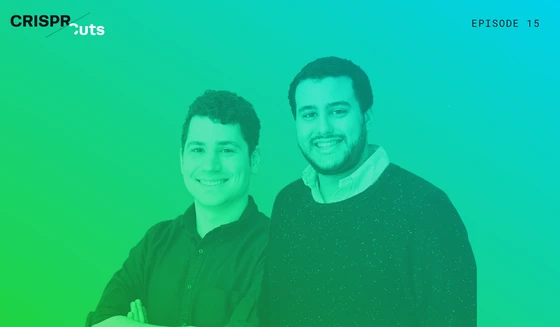
Developed by Omar Abudayyeh and Jonathan Gootenberg, SHERLOCK helped establish the potential of CRISPR systems beyond genome editing and accelerated interest in rapid, programmable molecular detection. The technology leveraged the discovery of CRISPR-associated enzymes such as Cas13 to create new approaches for detecting genetic material, including applications in infectious disease diagnostics.
In this conversation, Abudayyeh and Gootenberg share their journey from academic researchers to translating CRISPR innovation into diagnostic applications, including their work founding Sherlock Biosciences.
Listen to the podcast below, or jump into the transcript to learn more about the research, discoveries, and experiences that shaped the development of SHERLOCK.
3 Key Takeaways from this Podcast About SHERLOCK
In this conversation, Omar Abudayyeh and Jonathan Gootenberg discuss the research behind SHERLOCK, a CRISPR-based diagnostic platform that demonstrated how programmable CRISPR enzymes could be used for nucleic acid detection. Here are three key insights from their discussion:
1. Cas13 helped unlock new possibilities for CRISPR-based diagnostics
A key breakthrough behind SHERLOCK was recognizing the potential of Cas13, a CRISPR-associated enzyme capable of targeting RNA sequences, for programmable nucleic acid detection. This discovery helped expand the potential applications of CRISPR beyond genome editing and into molecular diagnostics.
Time in podcast: 2:34
2. SHERLOCK demonstrated the ability to detect RNA and DNA targets
While Cas13 naturally targets RNA, SHERLOCK workflows can detect DNA targets by incorporating amplification strategies that convert DNA into RNA intermediates for Cas13-based detection. This approach helped demonstrate the flexibility of CRISPR-based diagnostic platforms.
Time in podcast: 7:24
3. SHERLOCK helped shape the future of rapid molecular diagnostics
The development of SHERLOCK highlighted the potential for combining programmable CRISPR detection with amplification technologies to create faster, more adaptable diagnostic workflows. While the field has continued to evolve, SHERLOCK remains an important milestone in the development of CRISPR-based molecular diagnostics.
Time in podcast: 11:13
Original Podcast Transcript (2020)
In this section of the conversation, Omar Abudayyeh and Jonathan Gootenberg discuss their educational backgrounds, how they met at MIT, and the research experiences that shaped their work in CRISPR technology and molecular diagnostics.
Historical Transcript Excerpt (Recorded in 2020)
Omar Abudayyeh: I did my undergrad at MIT a while ago in mechanical engineering and biological engineering. I went in very interested in working with biomedical devices and biotechnology, and that led me to doing an M.D./Ph.D. program at Harvard. I did the first year as a medical school student, and then completed my Ph.D. about a year ago from MIT. I have now put my medical training on hold to start a lab with Jonathan at MIT to continue tackling questions surrounding gene therapy and gene editing technology development.
Jonathan Gootenberg: I also did my undergrad at MIT — that's actually how Omar and I met. I was studying biological engineering and math. Then I went to Harvard to get my Ph.D. in systems biology, and I graduated about eight months ago. Since then, we've been running this new lab where we are exploring new questions in biological diversity.
Minu: So, both of you met in undergrad, and that's when you realized you liked working on similar things. Was it planned to work together later or did that just happen?
Omar & Jonathan: We didn't plan to both join Feng Zhang’s lab, but we had worked together on a senior design project that was actually a fun, crazy idea about engineering bacteria-like probiotics for some inflammatory disease, and it was a fun opportunity to work together. We actually continued doing some research together after that on new microscopy modalities. I think it was pretty fortuitous that we both ended up in Feng's lab.
Minu: You are now also working at the McGovern Research Institute, where both of you have your own labs. Could you tell us a little bit about other projects that you are working on or are interested in?
Omar & Jonathan: I think both of us are pretty interested in furthering gene editing and gene delivery technology. Gene editing still has limitations in that it's not efficient in all cell types, especially brain cells. Current gene editing tools still can't insert DNA well either. I think a lot of our work is looking at technologies that go beyond CRISPR, that can manipulate even more efficiently in more tissues, so that more diseases can be targeted.
Beyond that, we're also interested in a second problem with gene therapy which is that even if you have the perfect genome editor, it would still be hard to deliver these tools to the right tissue and right cells, and have them go in efficiently. We're currently trying to explore certain new types of viruses and other types of modalities that can better get nucleic acid into cells for that purpose. Those are our main two technology development approaches.
Beyond that, we're also understanding how using these tools to probe aging biology, and understand why cells become dysfunctional, and why they become senescent. If we can understand that better, we can determine if we can use our tools to actually reverse senescence and regenerate tissues across multiple aging-associated diseases.
Minu: And for a fun question, because you have such an interesting name of your company and your kit, between the two of you, who is Sherlock, and who is Watson?
Jonathan: I think the better question is who is Moriarty? The important thing about having a good working relationship is that we both have to have flexibility with our roles. It depends on the day, of course, but in general, it's probably half-half.
Minu: So it depends on the day?
Omar: I guess I have more of the medical background, so maybe I'm closer to Watson in that regard. I think the more important thing is what's the next acronym that we can think up because that was certainly the hardest part of SHERLOCK — figuring that out! There were a lot of different iterations it went through. I think it's really important to have fun with the day-to-day; that's what makes it a great experience.
Minu: Absolutely. I think you guys have done a great job, and you've certainly set the bar for abbreviations really high! Every CRISPR researcher now has to step up to that level if they want to come up with any abbreviations. We are looking forward to what your next one will be!
How SHERLOCK Unlocked New Possibilities for CRISPR Diagnostics
How did researchers discover Cas13, and how did this CRISPR-associated enzyme become the foundation for SHERLOCK?
In this conversation, Omar Abudayyeh and Jonathan Gootenberg discuss the research journey that led to SHERLOCK, including the discovery of Cas13, how its unique RNA-targeting properties enabled new diagnostic approaches, and how CRISPR systems could be adapted for sensitive detection of genetic material.
Historical Transcript Excerpt (Recorded in 2020)
Minu: One of the main things in your project was the discovery of Cas13, which was fundamental to the development of SHERLOCK. Can you talk a little bit about how you came to find this enzyme and how that led you to where you are now?
Omar & Jonathan: SHERLOCK is our highly-sensitive and specific CRISPR diagnostics platform. It is really exciting that CRISPR can be used for sensing nucleic acids with implications for disease detection, but we definitely didn't go into graduate school interested in diagnostics. I was much more excited about molecular tool development, gene therapy, and treating diseases.
As a part of that, both of us were really interested in exploring the diversity of CRISPR enzymes, so everyone was really excited about Cas9 six years ago. We had this question about what other enzymes in the CRISPR world existed, and if there are any that might have unique features that could be useful for things we hadn’t even conceived of yet.
We did a lot of bioinformatics to find the CRISPR system we characterized biochemically in bacteria. One of the really interesting ones was this Cas13 enzyme. It was unique because it targeted RNA instead of DNA, and that was fairly unique because the enzymes known at the time that we used for those tools were all DNA-targeted. Being able to go after RNA allows you to do so much: you can modulate genes, and you can edit residues on genes temporally so it's like a temporary gene modification.
We later realized you could use this for diagnostics as well, because when this enzyme is bound to its target, it would not only cleave its target, but it would also cleave other molecules in the solution. That property is kind of like saying "hey, I just found my target and I'm just going to cleave everything and tell everyone that I found this target." It's sort of a more abstract way of thinking about it.
We realized that we could put in these fluorescent reporters. When they would cleave they would become fluorescent, and this Cas13 would basically release fluorescence when they found a nucleic acid target. We were also able to make this test sensitive to a single molecule, so it was very quick and cheap. We went down this path very fortuitously from just asking these questions about CRISPR biology, and not really knowing what we would find. And we took that path to many different areas — including CRISPR diagnostics.
Minu: I remember reading about SHERLOCK for the first time, and then I think about a year later, there was an upgraded version which was even more sensitive. What struck me most was that the readout is so simple. Is it correct that the method is so sensitive that it can actually use strips in your sample, and you can actually see a readout on the strip?
Omar & Jonathan: Yes, that's correct. One of the great things about this CRISPR diagnostic platform is that by changing the piece of RNA or DNA that is cleaved by this activity that Omar talked about, we can change it from a readout by fluorescence to something that could be read out by a paper strip. There are also a few who have done it so it actually changes the optical properties of a fluid or even potentially electronic readouts. So, this kind of lateral flow paper-based diagnostic is really powerful because the modularity of the platform allows you to swap the readouts depending on the application.
It was just really fun to think about different ways to develop things. That's the cool thing about being in the lab and having these enzymes. It's really thrilling first to discover them. I remember when we first characterized Cas12, back when it was called Cpf1. It's like people thought there was only Cas9 and now, this is an entirely new thing.
That’s the discovery aspect, but even beyond that, once we have the technologies, you can kind of let your imagination run wild, and ask “what can we detect?” Can we detect cancer? Can we detect different patient mutations, viral DNA, bacterial DNA? Or, can we detect using a different color metric or other readouts? And the thing you don't see, of course, is there are so many things that we tried that failed. But you just have to keep trying and letting your imagination play with it. It can make really interesting stuff like this lateral flow readout.
Minu: That's a very interesting point, especially about the part of failing. In the end, you always see these amazing Science/Nature papers, and it's hard to imagine the hard work that has gone into it, and all the trial and error behind it. You're absolutely right. Just keeping at it is probably the best way to go about it.
Can you speak a little bit about the implications of detecting RNA? One thing is that a lot of viruses have RNA genomes. Where else could it be used to detect RNA instead of DNA?
Omar & Jonathan: Just to clarify, we can actually do both RNA and DNA detection. One of the important steps of this detection reaction is we do a pre-amplification before the Cas13 detection. If you are just doing Cas13 detection, it would get in the low, maybe picomolar-high femtomolar range of sensitivity, which is millions of molecules per microliter. But if we combined in the reaction a set of enzymes that can actually amplify the nucleic acids in solution a little bit, it can bring up a single molecule or ten molecules to a level where Cas13 can then detect it.
What we essentially do is we can turn RNA or DNA into a lot of DNA during amplification. Then in amplification, we add a T7 promoter so that we can take the amplified DNA and make it into RNA, and then the RNA is detected by Cas13. All of that works in one reaction, and it's very quick and very simple at one temperature. What it allows us to do is detect DNA and RNA.
To answer your question where RNA detection is also useful, there are a lot of RNA viruses, bacteria have RNA signatures, 16S-rRNA sequences, or even transcripts of antibiotic resistance genes. Cancers are also really interesting at the RNA level. A lot of transcripts are fused; genes become fused together and you can detect those in the RNA. Hopefully, in general, RNA signatures are better than DNA signatures because they are going to be at a higher copy number, so it's actually easier to detect them per cell or with whatever you're doing.
From Academic Discovery to Diagnostic Innovation: The Story of Sherlock Biosciences
How does translating a scientific discovery into a diagnostic technology differ from academic research? In this conversation, Abudayyeh and Gootenberg discuss their transition from academia to entrepreneurship and the challenges of moving SHERLOCK from a laboratory breakthrough toward real-world diagnostic applications.
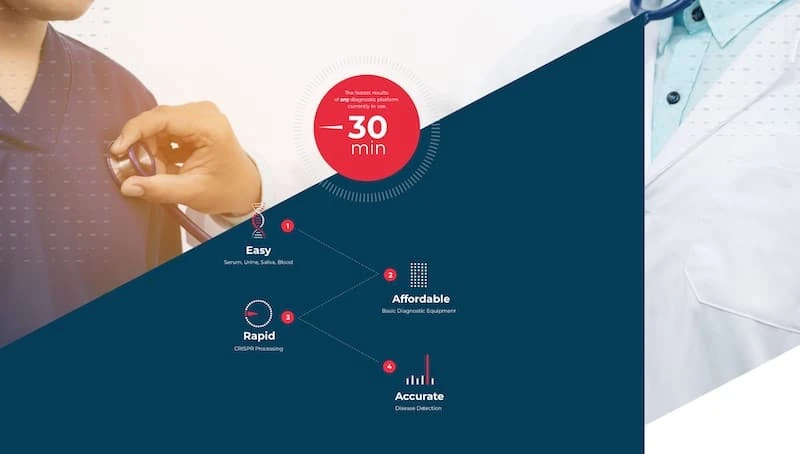
Founded to advance SHERLOCK technology and CRISPR-based diagnostics, Sherlock Biosciences represented an early effort to translate programmable nucleic acid detection into clinical and commercial applications. The company’s work highlighted the challenges involved in moving a promising research tool from proof of concept to reliable diagnostic workflows.
Historical Transcript Excerpt (Recorded in 2020)
Minu: Now that you have this great technology, you have started a new company: SHERLOCK Biosciences. Can you speak a little about what your roles will be in this company, and how you balance working in a lab and having a company of your own? It's a very interesting position to be in!
Omar & Jonathan: For us, it's a lot of fun to do the early academic development of these technologies when you publish really fantastic papers and get to talk about them at conferences. But, I think there's always that missing piece where you want to be able to say “what's next?” How do we take this work and really make an impact on society for people and patients?
It's hard to be in academia because of the capital that's needed to really scale and translate technology into a product. Because of that, I think getting to spin this off as a company has been a really rewarding experience; we get to interact with different types of people who are thinking about the business of how you actually get the capital to make a product that can make the company sustainable, and we work with people who think about how you make a test that's reliable and accurate across hundreds of patients.
It's one thing to have a proof of concept in the lab, but when you're deploying something that can actually inform how doctors make decisions about people's care and affect patient lives, you have to be sure that these tests are completely reliable, and will give you the right answer—every time.
It's definitely not easy work, but we've assembled a really good team. There are nine co-founders, including Feng Zhang and Jim Collins who originally helped us develop the technology when we were in their labs. We've brought on some other really awesome experts like David Walt who is a co-founder of Illumina, and has really been helping craft the business vision aspect of the diagnostics company. We have a fantastic CEO, Rahul Dhanda, who has 20 years of diagnostics experience. We have a really good team around this that, hopefully, can bring this to patients soon.
Minu: I hope so too, and best of luck with that!
The Future Vision for CRISPR Diagnostic Accessibility
When this conversation took place, CRISPR diagnostics were an emerging technology with significant interest in their potential to enable rapid and accessible molecular testing. Abudayyeh and Gootenberg discussed the future vision for CRISPR-based diagnostics, including the possibility of decentralized testing and broader accessibility.
Since this interview was recorded, the CRISPR diagnostics field has continued to evolve, with technologies progressing through research, development, and regulatory pathways. While widespread consumer availability has taken longer than initially anticipated, SHERLOCK and other CRISPR-based platforms helped demonstrate the potential of programmable nucleic acid detection.
Historical Transcript Excerpt (Recorded in 2020)
Minu: If you had to estimate, when do you think these diagnostic kits would be available in the market, and, would they be available for just anyone to buy, or will you be sending them to doctors only?
Omar & Jonathan: The future vision will be easy accessibility, because one of the really powerful aspects of the technology is that we can do testing wherever. Of course, there are many different iterations of the technology, and each of those has to go through different aspects of regulatory approval. I think that we will probably initially focus on not giving them directly to patients.
As for the timeline, that's always hard to predict, but we're moving quickly. We’re hoping to have products quite soon; because the technology is so easy to design and test, it’s easier to get something out rapidly.
Another thing, of course, is that the technology is not only being adopted by the company, but there's many different applications across human health, agriculture, and even the environment. We have collaborators who are interested in using it to track different ecological populations, for example, fish migrating on the West Coast or looking at different types of beetles.
It's really exciting to see how a foundational technology like this RNA detection can really be adopted by so many people to make a difference in so many areas.
The Future of CRISPR Technologies: Innovation, Discovery, and Public Understanding
CRISPR technologies have continued to evolve since SHERLOCK was first developed, with ongoing advances in enzyme discovery, molecular engineering, and new applications across biology and medicine. In this conversation, Omar Abudayyeh and Jonathan Gootenberg discuss their perspective on how CRISPR technologies mature over time, the potential for future discoveries, and how public understanding of CRISPR continues to develop.
Historical Transcript Excerpt (Recorded in 2020)
Minu: Recently, in the last one or two years especially, there have been so many CRISPR-related companies, and CRISPR research is accelerating. One of the things I was curious about was that CRISPR itself is fairly new - it's less than a decade old - so how do you think the next five years are going to change this field?
Omar & Jonathan: Of course, as this technology becomes more and more available, the applications will be more and more impressive. One great thing about having all of these different methods out there is that it really creates a versatile toolbox for people to use in biology. That will be quite amazing to see.
I think it's always great to bet on biodiversity being more and more surprising. I think we'll continue to find new enzymes and new techniques, and those will probably allow us to do things that we haven't done before, such as more efficient integration into non-dividing cells and other aspects.
Lastly, I think that as people become more familiar with the techniques, the efficiency will certainly go up. As these new techniques are coming through, they always involve an aspect of debugging. If you look at the original Cas9 genome engineering paper, the editing efficiencies are actually quite low compared to what you might expect today.
Of course back then, they were incredibly transformative, but you can just see how a technology - once it has its initial debut - matures, becoming better and better over time. We'll see that maturation of these technologies, and people getting higher and higher efficiencies with editing across more complex models as well. It's really an exciting time, and I think that there is much, much more to be discovered.
Minu: It is absolutely an exciting time! You mentioned people getting more used to the technology. In the scientific community, sure, they'll make even more developments. On the public side, I don't know if you have had the chance to talk about your technology with the general public or non-scientists, but, if you have, can you tell us a little bit about how people are perceiving this technology and if you think that will improve with time or, are they already excited about this?
Omar & Jonathan: We've given some talks to general audiences before, and I think most people leave feeling inspired and excited about the technology. It's probably because they are sort of interested from the perspective of treating disease. I think CRISPR has so much potential to treat disease and actually cure people of diseases that are really nasty. It also goes beyond healthcare where agriculture can make farming much easier with better crop yields.
I think in general when people hear those applications, they feel pretty good about it. I think more recently there have been a lot of questions with things like the CRISPR babies in China and what's going on with that. “Why are people upset about it and what does it mean?” I think we find ourselves explaining that type of situation and what the difference is between gene editing and treating diseases.
I also think one component of it is that a lot of people don’t appreciate the difference between the fact that if you treat someone's disease, you're not actually propagating genetic information that will go to someone's kids. Part of solving this is just explaining what all these CRISPR companies are actually doing, and how it can make a really big difference. It's not going to do anything that's ethically dubious.
Overall, in our experience, people seem pretty optimistic. But, there is definitely explaining we have to do.