
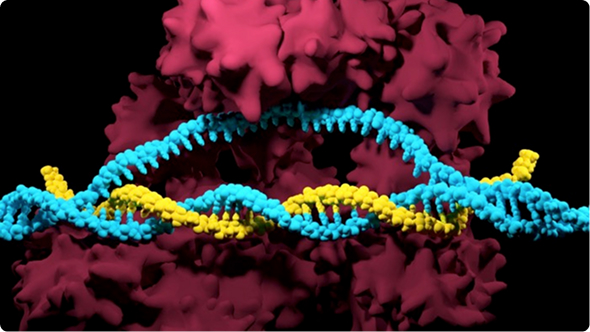
In the previous chapter, you learned how single guide RNA (sgRNA) directs the CRISPR system to its target DNA sequence. We compared the three main sgRNA formats—plasmid-derived, in vitro transcribed (IVT), and synthetic sgRNAs—and discussed the tradeoffs between them in terms of editing efficiency, reproducibility, scalability, and suitability for therapeutic applications.
In this chapter, you'll learn how to choose the right Cas variant based on the edit you want to make, your target sequence, and the requirements of your experiment.
While the sgRNA determines where CRISPR edits the genome, the Cas protein determines how that edit is made. Different Cas proteins recognize different PAM sequences, which are short DNA sequences that your target genomic sites must border. Therefore, different Cas proteins can affect which regions of the genome you can edit.
Choosing your Cas protein and gRNA candidates are therefore dependent on PAM sequences, and vice-versa. You should always consider these three elements together and align them with your experimental goals. Let’s start by looking at the different Cas protein options available and how they can help you achieve your desired edit.
When choosing your Cas protein, here are some features to think about:
|
Cas Variants
|
Example Cas Enzymes
|
Primary Use
|
Advantages
|
Typical Applications
|
PAM Requirement
|
|
Cas Nucleases
|
SpCas9, SaCas9, Cas12a (Cpf1), eSPoT-ON, hfCas12Max
|
Permanent genome editing
|
High editing efficiency, supports knockouts and HDR-mediated knock-ins, broad tool availability
|
Gene knockouts, gene knock-ins, functional genomics, cell engineering
|
NGG (SpCas9), NNGRRT (SaCas9), TTTV (Cas12a)
|
|
Cas Nickases
|
nSpCas9 (D10A or H840A), nSaCas9
|
High-specificity DNA editing
|
Reduced off-target activity, can be paired for targeted DSBs, foundation for prime editing
|
Precision editing, paired nickase strategies, prime editing
|
NGG (nSpCas9), NNGRRT (nSaCas9)
|
|
dCas (Dead Cas)
|
AccuBase, dSpCas9, dCas12a
|
Gene regulation and targeting
|
Binds to DNA without cutting it. Nuclease can be coupled with other proteins to activate or repress genes, edit individual nucleotides (base editing), or fluorescent tags.
|
CRISPRi, CRISPRa, Base editing, epigenetic editing, live-cell imaging
|
NGG (AccuBase, dSpCas9), TTTV (dCas12a)
|
|
RNA Cas
|
Cas13a, Cas13b, Cas13d (CasRx)
Various DNA-Cas, with the use of reverse transcriptases
|
Transient RNA manipulation
|
Reversible, avoids permanent genomic changes, ideal for RNA knockdown and detection
|
RNA knockdown, RNA editing, transcript imaging, molecular diagnostics
|
No PAM required (with some exceptions)
|
Cas nucleases are the most widely used CRISPR enzymes for genome editing. They create a double-stranded break (DSB) at a specific DNA sequence directed by a guide RNA (gRNA), which is then repaired by the natural DNA repair pathways of the cell. There are two separate repair mechanisms, enabling researchers to either disrupt genes with random insertions or deletions of bases (indels) or introduce precise genetic changes.
Because of their high editing efficiency and versatility, Cas nucleases are commonly used for gene knockouts, knock-ins, functional genomics, and cell engineering. However, this high efficiency comes with a tradeoff; double-stranded breaks may occasionally lead to large genomic rearrangements. Naturally found Cas nucleases include SpCas9, SaCas9, and Cas12a, each of which recognizes a different PAM sequence and offers unique advantages for specific experimental applications. Synthego also offers eSpOT-ON, and hfCas12Max, high-fidelity engineered Cas nucleases when you need high precision.
Cas9 is currently the most widely known nuclease in CRISPR experiments, specifically the Cas9 variant isolated from the bacterium Streptococcus pyogenes (SpCas9). SpCas9 is a non-engineered, natural Cas enzyme.
Although Cas9 is the most widely CRISPR variant used in genome engineering experiments, it does have certain limitations.
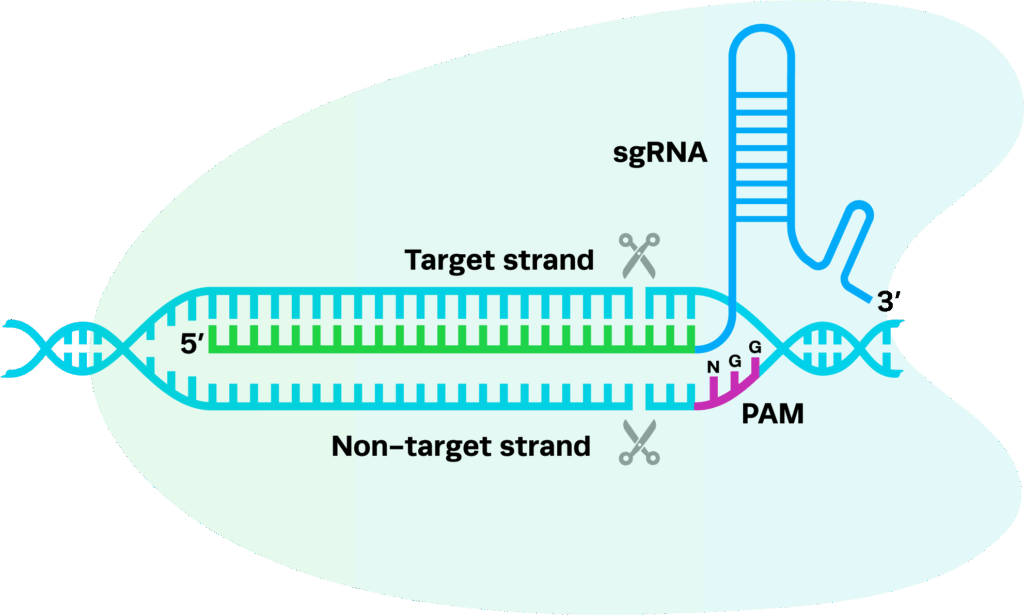
Staphylococcus aureus Cas9 (SaCas9) is an increasingly popular natural Cas nuclease. At just 1053 amino acids in length, it’s about 1 kb smaller than the traditional SpCas9. This means that it can be easily packaged into viral vectors, like the FDA-approved Adeno-associated viruses (or AAVs for short), making it ideal for clinical applications. SaCas9 recognizes a 3’-NNGRRT PAM sequence, generates blunt-end double-strand breaks (DSBs).
The highly restrictive PAM requirement, increased immune reactions (adults often have a pre-existing immunity against S. aureus), and risks of off-target effects are the main limitations of SaCas9.
Cas12a (formerly Cpf1), first characterized by Zetsche et al., is a CRISPR nuclease that offers several advantages over Cas9 for specific genome editing applications:
Cas12a shows one last interesting and useful trait; once it binds to and cleaves specific dsDNA, it is activated to indiscriminately and non-specifically cut any single stranded DNA (ssDNA). This ability of Cas12a makes it great for CRISPR diagnostics that use reporter ssDNA that produce a signal when cut. Dr. Jennifer Doudna and her group have developed such as a method termed DNA Endonuclease Targeted CRISPR Trans Reporter (DETECTR). By coupling Cas12a and its variants with single-stranded DNA (ssDNA) reporter probes, researchers paved the way for a new generation of highly sensitive CRISPR-based diagnostic platforms.
CRISPR diagnostics are transforming disease detection—making it faster, more flexible, and more accessible. Learn how this technology works and how you can apply it to your diagnostic development.

Developed by AstraZeneca, the eSpot-ON nuclease is an engineered Cas9 variant originally found in the genome of the bacterium Parasutterella secunda. The wild-type PsCas9 nuclease was highly active but lacked the high fidelity critical for the development of CRISPR medicines. By testing a variety of mutations to the RuvC, wedge (WED), and PAM-interacting domains of the nuclease, scientists created a superior engineered PsCas9 (published as ePsCas9) variant. Some engineered high-fidelity SpCas9 nucleases typically come with the trade-off of having lower on-target editing, but ePsCas9 achieves exceptionally low off-target editing while retaining its robust on-target activity.
Commercially available as eSpOT-ON in both recombinant protein and mRNA formats, ePsCas9 nuclease is only one part of this high-fidelity CRISPR therapeutic solution. The optimized gRNA for eSpOT-ON is reduced in size, increasing its stability and supporting the interaction between nuclease and guide to enhance editing efficiencies. The eSpOT-ON nuclease recognizes the same PAM sequence as SpCas9 (NGG) but creates sticky-end DSBs, leaving three-nucleotide 5’ overhangs. This not only promotes gene insertion via HDR, but also reduces the likelihood of chromosomal translocations, which are one of the key safety concerns associated with gene therapies.
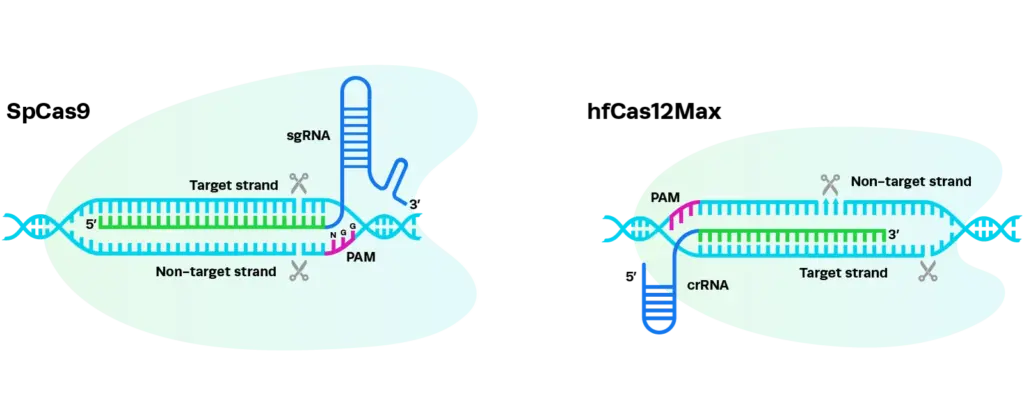
Utilizing their HG-PRECISE platform, HuidaGene Therapeutics engineered hfCas12Max from Cas12i of the Cas12 type V CRISPR-Cas nuclease family. This engineering resulted in hfCas12Max having enhanced gene editing capabilities while reducing unwanted off-target editing - making hfCas12Max a high-fidelity nuclease. Although engineered, hfCas12Max produces staggered-end cuts like other Cas12 nucleases. In addition to its high fidelity, hfCas12Max has a broader PAM sequence recognition profile (5’ - TN) that enables scientists to target regions of the genome that other common Cas nuclease cannot.
What helps make hfCas12Max stand out as a potential nuclease to use in CRISPR-based therapeutic development is its small size. Being only 1080 amino acids in size, and only requiring the short crRNA section of gRNA, hfCas12Max nuclease and gRNA could be packaged into lipid nanoparticles (LNPs) and AAV delivery systems (for reference, that is 22.5% smaller, or ~900 bps more space in an average AAV.).
HuidaGene Therapeutics has developed their CRISPR-based therapeutic using hfCas12Max to treat Duchenne muscular dystrophy. This drug is referred to as HG302 in their clinical pipeline and it passed early phase 1 clinical trials. The next generation of CRISPR-based therapeutics could potentially use hfCas12Max.
Cas nickases are modified versions of Cas nucleases, where one of the two catalytic amino-acid residues is inactivated, resuting in a Cas enzyme that only cuts strand of DNA instead of both. By creating a single-strand break - a nick - Cas nickases avoid the risks involved in creating DSBs and can result in improved editing specificity. Nickases serve as the foundation for several precision editing technologies, including prime editing, where a nickase is combined with a reverse transcriptase to introduce targeted genetic changes. In certain applications, two nickases can be used together to generate a DSB only when both bind to adjacent DNA sequences, significantly reducing off-target mistakes compared to a standard Cas9 nuclease.
Catalytically inactive, or "dead," Cas (dCas) proteins have both of their catalytic amino-acid residues inactivated. They retain their ability to strongly bind to their specific DNA sequence but lack the ability to cut it. Instead of editing the genome themselves, dCas proteins act as programmable, highly precise DNA-binding platforms that can carry other genome editing proteins to specific genomic locations.
dCas has been fused with many different epigenetic modifiers, such as transcriptional activators or repressors. You can also find dCas with fluorescent proteins used for imaging purposes. However, the arguably most exciting application has been the development of base editors, where dCas is paired with a deaminase enzyme to introduce targeted single-base changes without cutting the DNA.
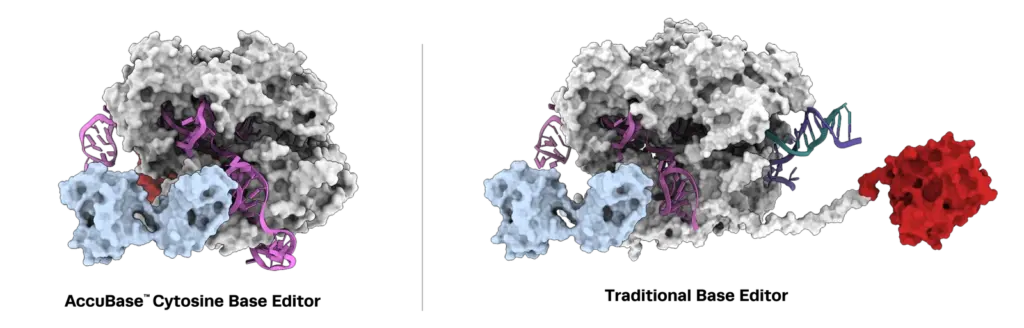
Base editors allow the use of precisely correcting single nucleotide mutations without creating DNA breaks, making them a highly promising avenue for clinical gene therapies where safety is a top priority. However, there is a catch.
In most base editors, the deaminase enzyme is fuse outside of the Cas protein with a linker. This results in a certain degree of inaccuracy with the "editing window", which is the area of the genome where base edits may occur. Synthego's AccuBase™, addressed this issue by embedding their deaminase enzyme inside the Cas protein instead, fixing it in place, giving it a significant advantage over traditional base editors.
Unlike Cas9 and Cas12 enzymes, which target DNA, RNA-targeting Cas proteins such as Cas13 recognize and modify RNA molecules. Because RNA edits are transient and do not permanently alter the genome, RNA-targeting CRISPR systems are well suited for applications where temporary gene regulation or transcript manipulation is desired. There are also dCas13 enzymes that can be used for detecting specific RNA sequences, similar to their DNA dCas counterparts.
RNA-targeting Cas proteins are widely used for RNA knockdown, RNA editing, transcript imaging, and molecular diagnostics. Their ability to manipulate gene expression without changing the underlying DNA sequence provides researchers with a flexible alternative for studying gene function and developing diagnostic and therapeutic applications.
Cas3 differs significantly from other Cas nucleases. While Cas9 and its relatives will create clean, double-stranded breaks in DNA, Cas3 degrades DNA, moving along one strand and effectively ‘shredding’ it. It also lacks any PAM sequence requirements, being activated when the CRISPR-associated complex for antiviral defense (CASCADE) recognizes a target. Since it performs long-range, progressive, unidirectional DNA cleavage, Cas3 can effectively delete large regions (~10kb) of a target genome. This gives it the potential for many therapeutic targets, such as the removal of viruses that insert into host genomes and to elimination of antibiotic-resistant bacteria.
Just like different tools are suitable for different functions, the choice of the nuclease to use in CRISPR experiments differs depending on the experimental goals. Synthego's CRISPR nuclease portfolio includes the gold standard of gene editing, SpCas9, the novel high-fidelity Cas12Max, also referred to as hfCas12Max, and its newest nuclease engineered specifically for therapeutic applications, eSpOT-ON offered as recombinant protein and mRNA format. As your CRISPR Guide, we offer a full continuum of CRISPR solutions that can be used in various applications and enable the seamless development of your CRISPR-based therapeutics from the discovery to the clinic.
With your nuclease decided, now it is time to select where you want to target on the genome. You learned the first two factors that affect target selection in gRNA and nuclease selection. In the next chapter, we will cover how PAM sequences determine the genomic regions we can target, their effects on off-target binding, and other considerations.
Recombinase Polymerase Amplification (RPA) coupled with CRISPR-based detection offers a rapid, highly sensitive, and isothermal molecular diagnostic framework, bypassing the need for complex thermal cyclers. Operating at a constant 37°C...
Advancing a CRISPR program becomes more complex at every stage.
Cell-free protein expression (CFPE) systems enable rapid prototyping of protein constructs by expressing genes directly from engineered DNA templates in vitro. While linear templates allow fast iteration, circular DNA templates...
 Cart
Cart
 Account
 Your Orders
 Sign Out
 Sign In