
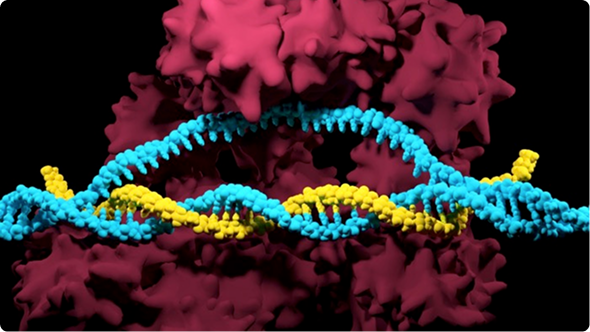
Now that you understand the roles of gRNAs, nucleases, and PAM sequences, it is finally time to design your gRNAs. Good gRNA candidates target the right regions of the genome for your desired edit, while balancing binding efficiency and off-target risks. The location you choose will depend on your experimental goal, whether you are disrupting a gene, introducing a precise genetic change, or modifying gene expression. In this chapter, you'll learn how to identify appropriate target regions for different CRISPR applications and how to use these decisions as the foundation for designing effective guide RNAs.
The first step in identifying your target region is understanding what you want to accomplish with your CRISPR experiment. Your editing goal determines where the genome you should target, and which regions are most likely to produce the desired outcome.
Here are some of the targeting considerations for common CRISPR applications:
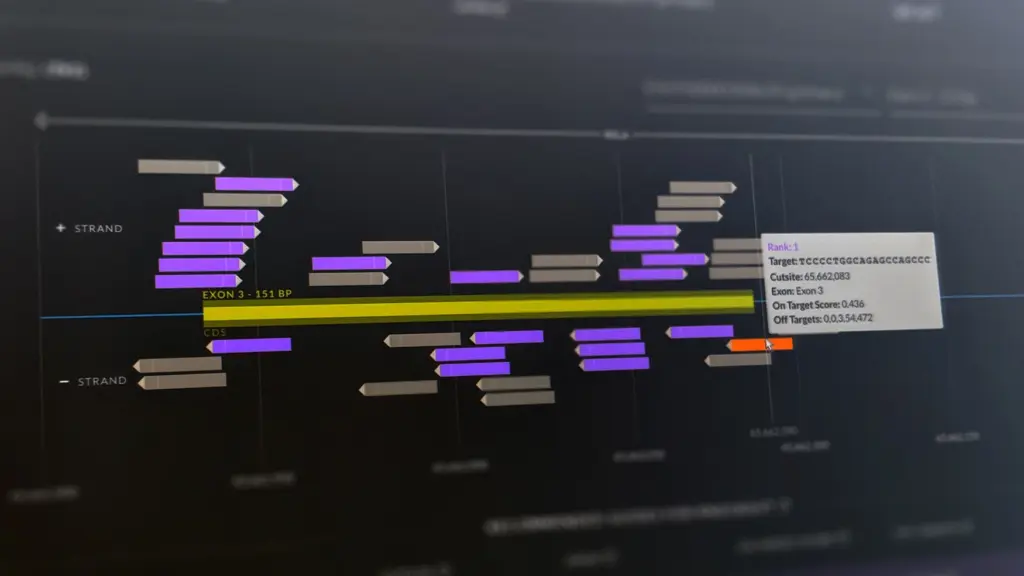
After selecting your target genomic region, it is time to design guide RNAs (gRNA) for that region. Researchers often test multiple gRNAs (3-5) for each target because, although design algorithms can help predict guide performance, the actual editing efficiency of a gRNA can vary depending on the experimental system.
When designing guide RNAs, you will need to evaluate multiple factors, including target location, PAM compatibility, predicted editing efficiency, and potential off-target effects. While these decisions can be made manually, CRISPR guide RNA design tools simplify the process by analyzing genomic sequences and ranking potential guide candidates based on established design criteria. You can find some of our favorite free online tools for CRISPR gRNA design here.
These tools use computational models trained on thousands of gRNA datasets to generate gRNA candidates. Candidate gRNAs are scored according to their likelihood of a good-bind to the target region, as well as for the likelihood of binding to off-target sites.
Most design tools base their calculations on "Doench rules", which were published by John Doench, with the most recent model dubbed Rule Set 3.
After generating a list of potential guide RNAs, the next step is selecting the candidates most likely to perform well in your experiment. While design tools provide useful predictions, guide selection should consider multiple factors, including predicted on-target activity, off-target potential, and the location of the target site within your genomic region.
A high-quality guide RNA should efficiently direct the Cas nuclease to the intended target while minimizing the likelihood of unintended edits elsewhere in the genome. When comparing guide candidates, consider:

Our research-grade sgRNAs delivers high quality, highly pure synthetic guides that gives you the reliable performance you need for your experiments.
A well-designed gRNA combines the right target location, strong predicted activity, low off-target potential, and compatibility with your chosen Cas enzyme. By considering these factors together, you can improve your chances of achieving efficient and reproducible genome editing.
When you are comparing your candidates, consider:
You have invested in your time and efforts to acquire the best possible gRNAs and Cas proteins for your experiment. Now, it is time deliver them to your cells. Because every cell and every CRISPR experiment is different, the best delivery method may change for each experiment. In the next chapter, we will cover different in vitro CRISPR delivery methods for editing your cells.
CRISPR has quickly become a standard laboratory tool for gene editing. As the adoption of CRISPR accelerates worldwide, up-to-date knowledge of the basics of CRISPR is essential for anyone in...
CRISPR has ignited a revolution. Although it’s a relatively recent discovery in the history of biotechnology, CRISPR has quickly become a standard laboratory tool and is transforming cell engineering-based research....
Confused about chemical modifications on CRISPR guides? Join us as we explore why chemical modifications are so important, the different types and their applications, and how Synthego’s modified guides can...
 Cart
Cart
 Account
 Your Orders
 Sign Out
 Sign In