
Every CRISPR experiment starts with three interconnected decisions - the type of sgRNA to use, picking the right Cas variant, and identifying exactly where you want to target on the genome. These three decisions are all interconnected, and a successful CRISPR experiment requires balancing these factors together. We will cover the last factor of this equation.
When choosing your genomic target, you are limited to sites located near a compatible protospacer adjacent motif (PAM) sequence, making PAM availability a critical factor in guide RNA design and target selection. In this chapter, we will explore what PAM sequences are, how they influence CRISPR targeting, and how to identify the best genomic location for CRISPR editing.
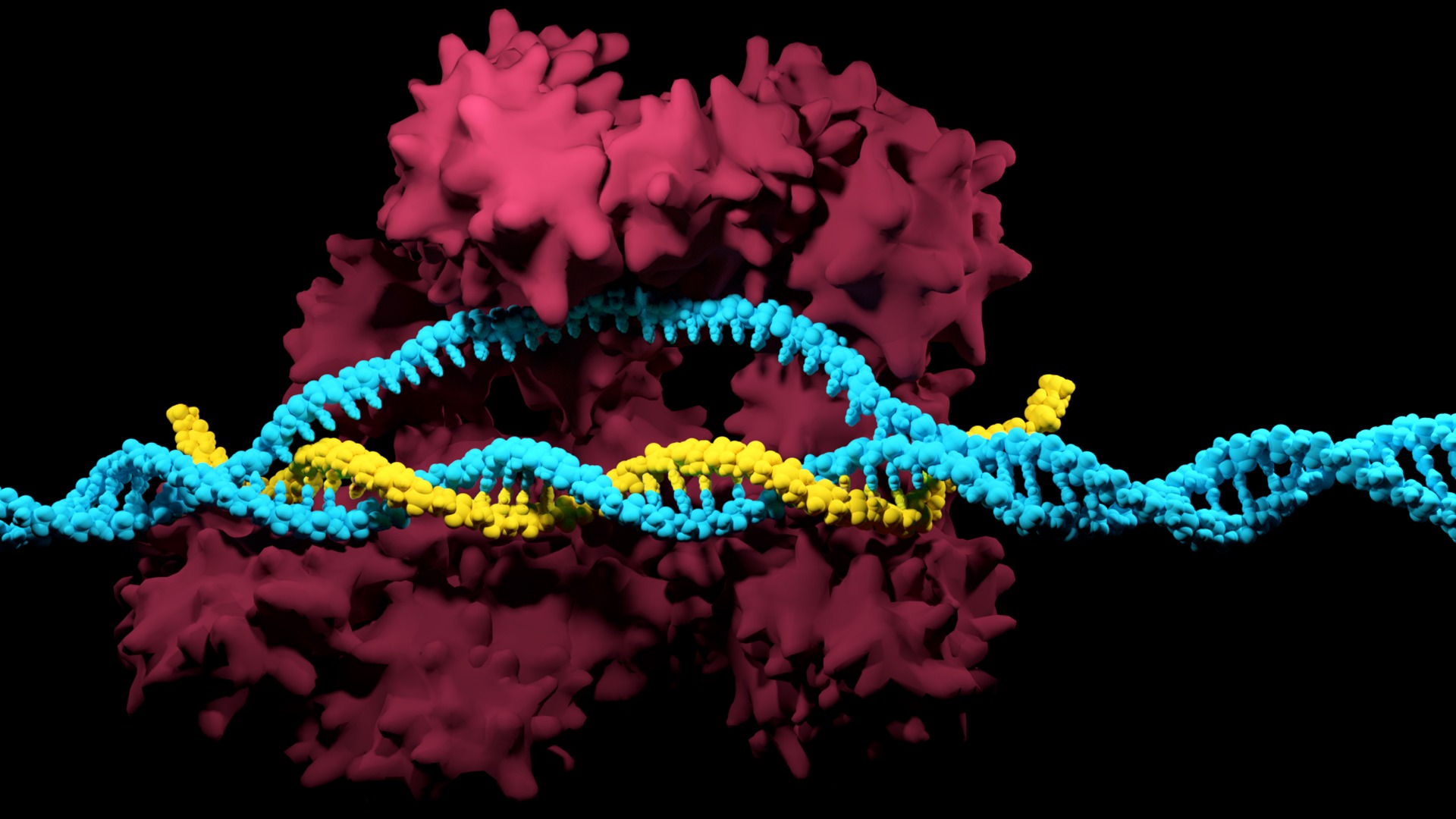
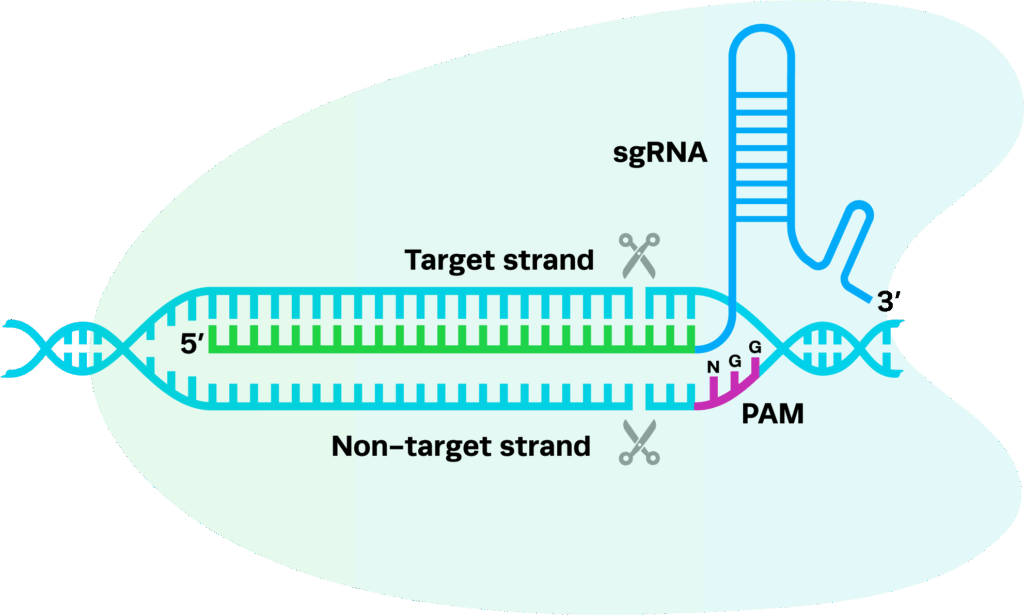
Before a Cas nuclease can bind to its DNA target, it must first locate a protospacer adjacent motif (PAM). A PAM is a short DNA sequence (typically just 2–6 base pairs long) that needs to sit immediately next to the region you want to edit. This is because, rather than scanning every base in the genome for a gRNA match, the Cas nuclease first searches for its specific PAM sequence. Only after recognizing a valid PAM does it unwind the neighboring DNA and check whether it matches the guide RNA. If both the PAM and guide RNA match are correct, the nuclease proceeds to make its cut.
Fortunately for our targeting purposes, PAM sequences are common throughout the genome. For example, the SpCas9 nuclease recognizes the sequence NGG, where "N" can be any nucleotide. This motif occurs, on average, once every 42 base pairs in a random DNA sequence, meaning most genomic regions contain multiple potential editing sites. However, not every target of interest will have an appropriately positioned NGG sequence.
When that happens, researchers can often choose a different Cas nuclease with an alternative PAM requirement. Because different CRISPR systems have naturally evolved to recognize different PAM sequences, selecting the right nuclease can greatly expand the range of genomic sites that can be edited.
The PAM serves as an essential checkpoint for CRISPR editing because it determines which regions of the genome are accessible to a particular Cas nuclease. A genomic target may be ideal from a biological perspective, but without a compatible PAM nearby, that site cannot be edited by that nuclease. In other target sites, multiple nearby PAMs might provide you with flexibility, allowing you to design and compare several guide RNAs before selecting the best candidate. For this reason, choosing a target site is often a balance between biological relevance and the availability of suitable PAM sequences.
PAM selection can also play an important role in reducing off-target editing. An off-target cut can only occur when two conditions are met: the gRNA binds a sufficiently similar DNA sequence, and that sequence is adjacent to a compatible PAM recognized by the Cas nuclease. If either requirement is missing, editing will not occur. This becomes particularly important when targeting gene families, pseudogenes, or other highly similar genomic regions. In these cases, choosing a nuclease with a longer or more restrictive PAM requirement can reduce the number of potential off-target sites by limiting where the Cas protein can bind. Therefore, PAM selection is an important consideration alongside guide RNA sequence design, helping researchers balance target accessibility, editing efficiency, and specificity.
When CRISPR first evolved in bacteria, it needed a way to distinguish invading viral DNA from the viral fragments stored in the bacterial genome as an immune memory. PAM sequences provide this distinction. Cas nucleases have evolved to require a PAM before binding and cutting DNA, while bacteria store viral DNA fragments without the corresponding PAM sequence. As a result, the bacterial genome is protected from being mistakenly recognized and cleaved by its own CRISPR system.
Researchers follow this same principle when designing guide RNAs for CRISPR experiments. The guide RNA is designed to match the target DNA sequence, but it typically does not include the PAM itself. This is particularly important for plasmid-based CRISPR systems. Because the guide RNA is encoded as DNA within the plasmid, including a PAM alongside the guide sequence could cause the Cas nuclease to recognize and cleave the plasmid carrying the guide RNA, reducing the efficiency of the experiment.
At first glance, PAM sequences can look a little confusing because they don't always use the familiar A, T, C, and G. Instead, they often include IUPAC nucleotide codes, where a single letter can represent multiple possible bases.
The most common codes you'll come across are N, which means any nucleotide, R, which represents either A or G, and V, which means A, C, or G (anything except T).
The most commonly-used Cas9 from Streptococcus pyogenes, also referred to as SpCas9, recognizes the PAM sequence 5′-NGG-3′. But what if the target genomic locus does not bear this NGG sequence? Researchers cannot afford to be limited by the presence of the specific PAM for their CRISPR experiments.
Thankfully, there are many different Cas endonucleases to choose from isolated from different bacterial species, and each recognizes a different PAM. For instance, Cas9 of Straphylococcus aureus recognizes NNGRRT instead, allowing access to a different genomic target.
The ingenuity of researchers has also enabled the CRISPR community to move beyond naturally occurring Cas proteins and instead engineer them to meet their research needs. Using directed evolution, researchers can rapidly screen hundreds of thousands of variants, before identifying a small number of enzymes with new PAM recognition properties. Another complementary approach uses bioinformatics to compare naturally occurring Cas enzymes, helping researchers predict how sequence differences influence PAM recognition and identify promising variants for experimental testing. These studies led to the development of Cas nucleases such as hfCas12Max, an engineered high-fidelity Cas12 variant, with the highly flexible PAM sequence of 5'-TN and/or 5'-TNN. There have even been efforts to generate "PAM-less" Cas enzymes, such as the engineered SpCas9 variant, SpRY, which can target almost all PAM sequences (albeit at varying efficiency).
By overcoming PAM limitations, these innovations are steadily increasing the portion of the genome that can be accessed and modified using CRISPR technologies.
Table 1: List of commonly used CRISPR-Cas nucleases and their PAM requirements.
|
CRISPR Nucleases
|
Organism Isolated From
|
PAM Sequence (5’ to 3’)
|
|
Streptococcus pyogenes
|
NGG
|
|
|
SaCas9
|
Staphylococcus aureus
|
NNGRRT or NNGRRN (at reduced efficiency)
|
|
NmeCas9
|
Neisseria meningitidis
|
NNNNGATT
|
|
Engineered from Parasutterella secunda Cas9
|
NGG
|
|
|
Engineered from Lachnospiraceae bacterium Cas12i
|
TN and/or TNN
|
|
|
CjCas9
|
Campylobacter jejuni
|
NNNNRYAC
|
|
StCas9
|
Streptococcus thermophilus
|
NNAGAAW
|
|
LbCpf1 (Cas12a)
|
Lachnospiraceae bacterium
|
TTTV
|
|
AsCpf1 (Cas12a)
|
Acidaminococcus sp.
|
TTTV
|
|
AacCas12b
|
Alicyclobacillus acidiphilus
|
TTN
|
|
BhCas12b v4
|
Bacillus hisashii
|
ATTN, TTTN and GTTN
|
|
Cas14
|
Sequence discovered from uncultivated archea, in vitro expressed in E. coli
|
T-rich PAM sequences, eg. TTTA for dsDNA cleavage, no PAM sequence requirement for ssDNA
|
|
Cas3
|
in silico analysis of various prokaryotic genomes
|
No PAM sequence requirement
|
Now that you learned about sgRNA, Cas proteins, and PAM sequences, the next step is designing your guide RNAs. Depending on your goals, you will identify target regions of the genome by balancing experimental goals (i.e. knocking out a gene), PAM site availability, and properties of the candidate gRNAs.
In the next chapter, we will cover how you can design gRNAs with free online tools, evaluate candidate guides quality, and select the best option for your CRISPR experiment.
Recombinase Polymerase Amplification (RPA) coupled with CRISPR-based detection offers a rapid, highly sensitive, and isothermal molecular diagnostic framework, bypassing the need for complex thermal cyclers. Operating at a constant 37°C...
Advancing a CRISPR program becomes more complex at every stage.
Cell-free protein expression (CFPE) systems enable rapid prototyping of protein constructs by expressing genes directly from engineered DNA templates in vitro. While linear templates allow fast iteration, circular DNA templates...
 Cart
Cart
 Account
 Your Orders
 Sign Out
 Sign In