
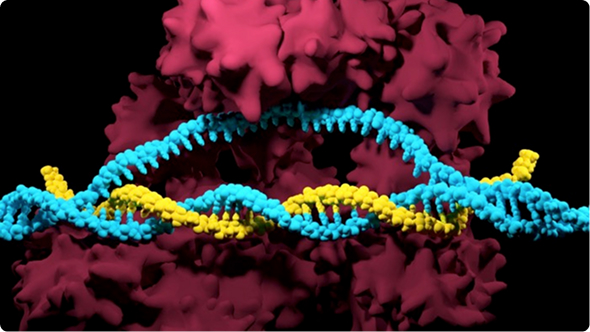
One of the main reasons behind CRISPR's success is the precision it offers for researchers. This precision comes from guide RNAs (gRNAs), which are short RNA sequences that binds to both the CRISPR Cas proteins and to a target DNA sequence on the genome, bringing them together. As the targeting element, using high-quality and well-designed gRNAs are essential in achieving the full potential of the CRISPR-Cas technology.
In this chapter, we will cover what the design guidelines for making a successful gRNA, while explaining different types of gRNAs along the way.
Before diving into single guide RNAs (sgRNAs), it's helpful to first understand how the CRISPR-Cas9 system works. At its core, CRISPR gene editing relies on two components working together: a guide RNA (gRNA) and a CRISPR-associated (Cas) nuclease.
Working together, the guide RNA and Cas nuclease allow researchers to make precise, targeted changes to the genome. Because the guide RNA determines where CRISPR acts, designing the right guide is one of the most important decisions in any genome editing experiment. A well-designed sgRNA can maximize on-target editing while minimizing unwanted off-target effects. Beyond directing standard genome editing, sgRNAs can also be paired with engineered Cas proteins—including catalytically inactive dead Cas (dCas) variants—to enable applications such as CRISPR activation and interference, base editing, prime editing, epigenome editing, and CRISPR-based diagnostics.
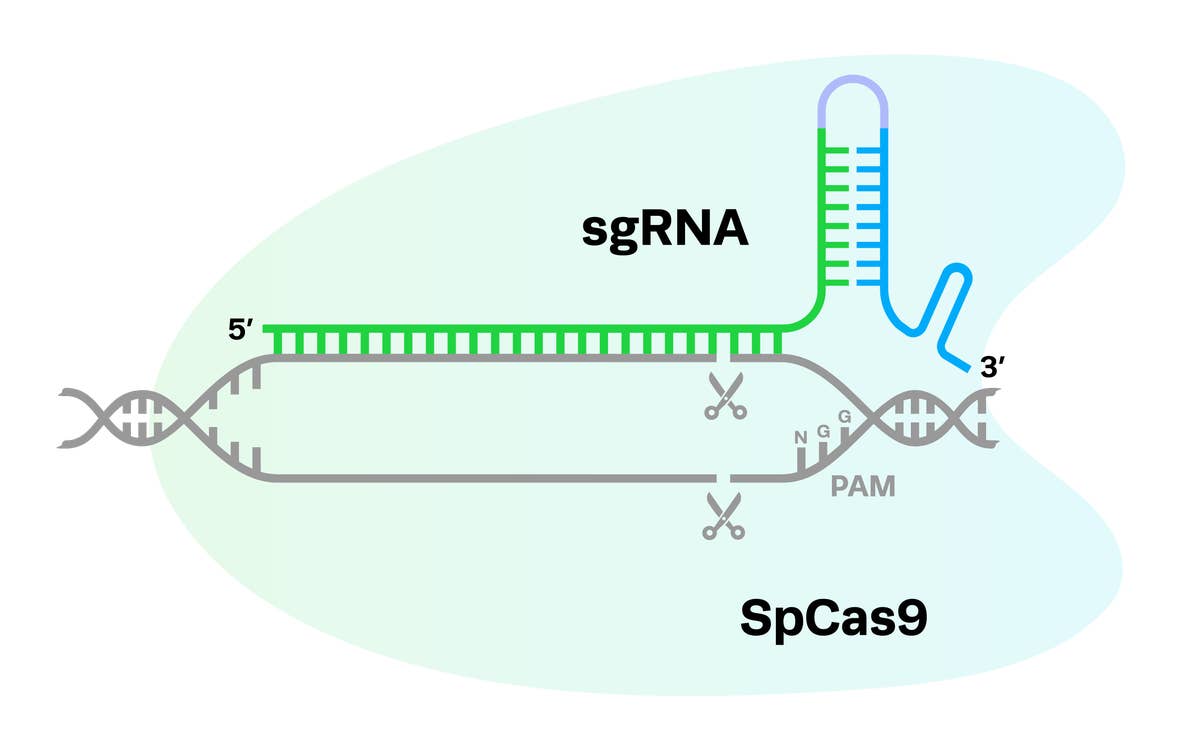
You may have noticed that both guide RNA (gRNA) and single guide RNA (sgRNA) are terms commonly used in CRISPR-related sources. So what exactly is the difference between gRNA and sgRNA?
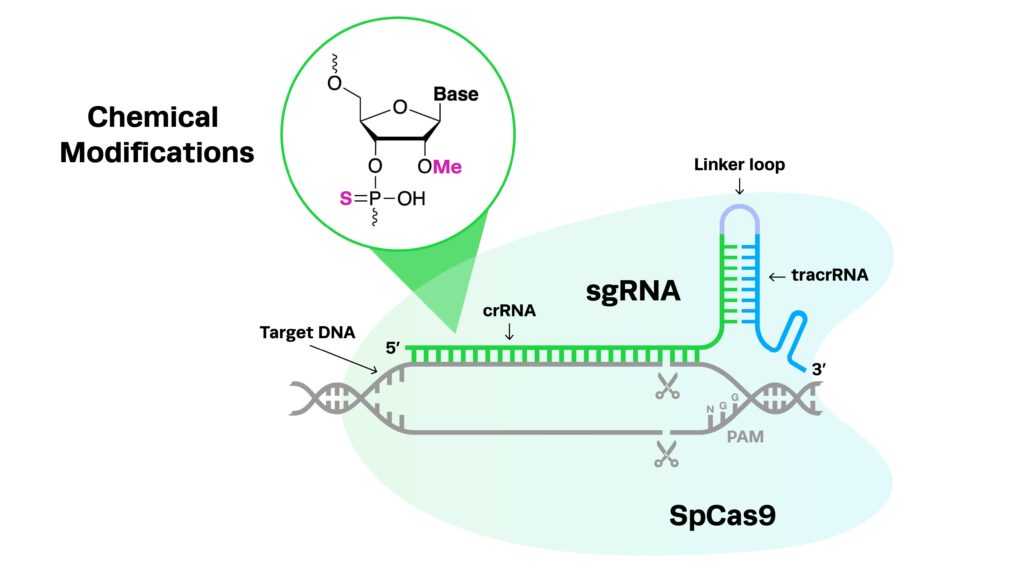
The gRNA refers to the combination of two separate RNA molecules; crRNA and tracrRNA. The crispr RNA (crRNA) is the part that gives CRISPR its precision - it is a 17-20 nucleotide sequence complementary to the target DNA. The tracrRNA serves as a binding scaffold for the Cas nuclease. The two-part gRNA system was how gRNAs were first discovered in nature, coupled with SpCas9 - the first Cas nuclease that was discovered. As researchers discovered more Cas variants in nature, we also found Cas enzymes such as Cas12, which does not require any tracrRNA, and works only with the crRNA for targeting.
While crRNA and tracrRNAs exist as two separate RNA molecules in nature, for convenience researchers combine these two fragments into one longer RNA, called a single guide RNA (sgRNA). While past manufacturing technologies struggled with sgRNA synthesis due to their longer length, improvements in chemical RNA synthesis technologies significantly improved the yield, purity and performance of synthetic sgRNAs.
Cells produce RNA through transcription, and for many years, we relied on this same process to generate gRNAs in laboratories. Researchers used bacterial cultures as organic factories, or recombinant enzymes in test tubes, relying on biology to produce gRNA.
While these methods remain valuable for certain applications, their lengthy production and purification workflows, transcription-related errors, and the presence of bacterial contaminants led to the development of chemically synthesized RNA. This approach provides researchers with a faster, more consistent, and more scalable method for producing high-quality guide RNAs. Furthermore, chemical synthesis allows researchers to generate modified gRNA that are more resilient to degradation, opening a new avenue for improvements.
|
Feature
|
Synthetic gRNA
|
IVT-derived gRNA
|
Plasmid-derived gRNA
|
|
Editing efficiency
|
Consistently high
|
Can vary depending on transcription quality and purification
|
Good due to sustained expression, with risks.
|
|
Time to experiment
|
Instant, ready to use out of the vial.
|
1-2 days, requires in vitro transcription, cleanup, and QC before use
|
1-2 weeks, requires cloning, bacterial amplification, and plasmid isolation.
|
|
Batch-to-batch consistency
|
Excellent
|
Moderate
|
Moderate
|
|
Duration of nuclease expression
|
Transient
|
Transient
|
Prolonged expression after plasmid delivery
|
|
Off-target editing risk
|
Lower due to transient activity and rapid degradation after editing (do mods help)
|
Lower than plasmids but dependent on QC and purification
|
Higher potential due to sustained Cas9 and gRNA expression
|
|
Clinical translation
|
Preferred for most gene therapies; compatible with GMP manufacturing.
|
Rarely used directly in therapeutic manufacturing.
|
Rarely used directly in therapeutic manufacturing.
|
|
Scalability
|
Highly scalable with consistent manufacturing
|
Moderate; IVT reactions require optimization when scaling
|
Limited by cloning and plasmid production workflows
|
|
Overall workflow complexity
|
Low
|
Moderate
|
High
|
Today, chemically synthesized single guide RNAs (synthetic sgRNAs) have become the preferred format for many CRISPR researchers, from basic research to clinical development. First developed by Synthego, synthetic sgRNAs eliminate the need for bacterial expression or in vitro transcription, allowing researchers to receive ready-to-use guide RNAs instead of spending days producing and purifying them in the laboratory.
When you are scaling your CRISPR workflows from discovery into more advanced applications, the advantages extend beyond convenience. Compared with plasmid- and IVT-derived guide RNAs, synthetic sgRNAs offer excellent batch-to-batch consistency and can be manufactured to exceptionally high purity in a more scalable, cost-effective manner. Furthermore, they are produced through the more defined chemical process, rather than a biological one. These factors together make them the choice for CRISPR clinical trials, where reproducibility, safety, and manufacturing consistency are essential.
Another advantage of chemical synthesis is that it allows chemical modifications to be incorporated directly into the guide RNA. Inside a cell, unmodified RNA is rapidly degraded by naturally occurring RNases, limiting how long it remains available for genome editing. By incorporating chemical modifications into your sgRNA, you can improve guide stability, extend activity inside cells, and potentially achieve more consistent editing outcomes. More specialized chemistries can also be incorporated to support the diverse needs of research and clinical development.
Synthetic sgRNAs are produced via solid-phase chemical synthesis. In this process, individual ribonucleotides are added one at a time to a growing RNA chain anchored to a solid support. Each nucleotide is incorporated through a series of carefully controlled coupling, capping, and oxidation reactions, while temporary protecting groups prevent unwanted side reactions until the next nucleotide is added.

Our research-grade sgRNAs delivers high quality, highly pure synthetic guides that gives you the reliable performance you need for your experiments.
One of the earliest and most widely used methods for generating sgRNAs is plasmid-based expression. With this approach, you clone your sgRNA sequence into a plasmid vector and introduce it into competent bacteria, where the plasmid is amplified. After selecting the transformed colonies and growing a culture, you can isolate the plasmid DNA and transfect it into your target cells. The cell then transcribes the sgRNA needed for CRISPR editing. Many commonly used plasmid backbones also encode a Cas nuclease, enabling you to deliver both the guide RNA and nuclease together in a single construct.
Delivering the sgRNA and Cas protein as a plasmid results in continuous expression of these components, which increases the efficiency and duration of your genomic edit. However, this long-term expression also increases the odds for off-target edits. Furthermore, the plasmid itself can integrate into the cellular genome, which can result in adverse effects and problematic for downstream applications, sometimes resulting in cause cell death.
The workflow also requires a considerable investment of time and effort before you can begin your experiment. Cloning your guide into a plasmid, transforming bacteria, expanding cultures, and purifying plasmid DNA typically takes one to two weeks. Because each guide RNA requires its own plasmid preparation (and most CRISPR experiments test three to five guides per target) you'll need to repeat this process multiple times, consuming valuable time and laboratory resources.
Another common method for producing sgRNAs is in vitro transcription (IVT). Rather than relying on bacterial cells to produce your guide RNA, IVT uses purified recombinant enzymes to synthesize RNA in a test tube. To begin, you'll need a DNA template containing both your sgRNA sequence and an RNA polymerase promoter, such as the T7 promoter. When this template is combined with T7 RNA polymerase, ribonucleotides (rNTPs), and RNase inhibitors, the polymerase recognizes the promoter and transcribes the DNA into sgRNA. After transcription, the sgRNA must be purified to remove enzymes, unused nucleotides, template DNA, and other reaction byproducts before it can be used for genome editing.
Compared with plasmid-based expression, IVT is considerably faster, with guide RNAs typically produced in one to three days. However, that speed comes with additional hands-on work. Because every sgRNA requires its own DNA template, each template should be sequence-verified before transcription to ensure the final RNA is accurate. The resulting sgRNA also requires careful purification, as residual template DNA, enzymes, or other contaminants can affect downstream experiments and, in some applications, trigger unwanted immune responses.
One of IVT's greatest strengths is its ability to generate long RNA molecules. While chemically synthesized sgRNAs are well suited for standard CRISPR editing, specialized applications such as prime editing often require extended guide RNAs that are 120–145 nucleotides long. These longer RNAs can be challenging to manufacture using chemical synthesis, making IVT the preferred approach for many of these applications.
Synthego’s best-in-class synthetic sgRNA have been cited in +4000 peer-reviewed publications from a variety of research areas including oncology, immunology, genetic disease, and neuroscience. To researchers, Synthetic sgRNA has several advantages over other sgRNA formats, four of which are listed here:
Editing cells with synthetic sgRNAs has been experimentally confirmed to be of higher efficiency compared to non-synthetically derived sgRNA. Optimized chemical modifications of Synthego's best-in-class sgRNA achieves up to 99% editing efficiency in immortalized cell lines and greater than 70% in resting human primary cells enabling experimental reproducibility.
RNA is a naturally fragile molecule and can be rapidly degraded by cellular RNases after delivery into cells. Therefore, during chemical sgRNA synthesis, modifications are made to the RNA structure that help protect it from degradation, improving their stability and extending their activity window for genome editing.
Synthego’s standard modifications, including 2′-O-methyl (2′-OMe) and phosphorothioate (PS) backbone modifications, are incorporated at key positions within the guide RNA to increase nuclease resistance while maintaining efficient target recognition and editing performance. You can also order sgRNA with more specialized modifications that are tailor-designed for your experimental needs. Learn more about sgRNA modifications in our blog, where we explore the different types of sgRNA modifications.
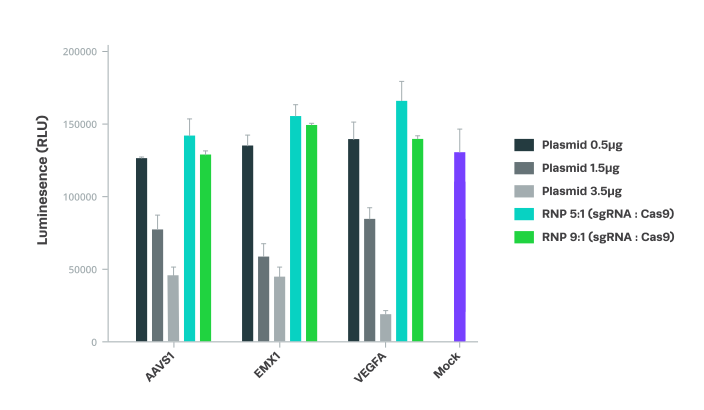
One caveat of DNA-based methods for generating sgRNA, especially the plasmid format of CRISPR components, is the continual expression of guide RNAs inside the cell. This long-term expression of the Cas enzymes and sgRNA increases the risks of off-target effects, which include large deletions or relocations of the genome. Our synthetic sgRNAs are modified to last in the cell for long enough to accomplish your CRISPR-Cas edit, then safely degrade, improving their safety.
Additionally, using synthetic sgRNA enables the use of ribonucleoprotein (RNP) format for CRISPR. Instead of using plasmids and mRNA to make the cell produce the sgRNA and Cas proteins, the RNP format combines recombinantly produced Cas proteins with sgRNA first, then delivers this combined complex to the cells.
There are significant benefits to using RNPs over plasmids and mRNA. RNP-CRISPR improves cell viability by off-loading the stress of transcribing and translating sgRNA and Cas proteins, reduces off-target edits, and speeds up the editing process by providing cells with ready-to-use CRISPR machinery.
Scientists developing CRISPR-based therapeutics face significant challenges when transitioning from discovery research to clinical development. Programs that begin with plasmid-derived or in vitro transcribed (IVT) sgRNA often require a switch to GMP-compliant synthetic sgRNA later in development, creating the need for additional optimization, comparability studies, and process validation. These activities can consume valuable resources and extend development timelines, delaying progress toward the clinic.
As a result, the majority of CRISPR clinical trials start with synthetic sgRNAs over alternative approaches, with approximately 80% of programs using synthetic guides to support the development of safer and more effective genome editing therapies.
To support your journey, Synthego’s CRISPR Continuum provides a seamless path from discovery to the clinic with high-quality CRISPR reagents tailored to the unique requirements of each stage of development. By providing Research Use Only (RUO), IND-enabling, and GMP-grade CRISPR reagents within a single quality framework, we help you transition between development stages with confidence while reducing delays and maintaining consistency.
Now that you learned about the different types of sgRNA, it is time to pick a nuclease to go with it. Our next chapter will cover everything you need to know about different Cas nucleases, and how to select the right nuclease for your CRISPR experiments.
CRISPR has quickly become a standard laboratory tool for gene editing. As the adoption of CRISPR accelerates worldwide, up-to-date knowledge of the basics of CRISPR is essential for anyone in...
CRISPR has ignited a revolution. Although it’s a relatively recent discovery in the history of biotechnology, CRISPR has quickly become a standard laboratory tool and is transforming cell engineering-based research....
Confused about chemical modifications on CRISPR guides? Join us as we explore why chemical modifications are so important, the different types and their applications, and how Synthego’s modified guides can...
 Cart
Cart
 Account
 Your Orders
 Sign Out
 Sign In